
















-
Incorrect tariff classification is a frequent cause of border delays and financial penalties because of regional variations in the final four digits of a commodity code.
-
The strategic roadmap involves three distinct phases: setting up a planning framework, gathering and analysing technical data, and defining a formal implementation plan.
-
A robust classification strategy must account for national interpretations, particularly in complex sectors like fashion and engineering where codes often diverge at the ten-digit level.
One of the most common causes of delays and penalties at the border is incorrect tariff classification. Global tariff classification is based upon the harmonised system (HS) nomenclature, published by the World Customs Organization (WCO), which classifies goods into over 5000 sub-headings for international trade. More than 200 countries use the HS Convention for the classification of goods. As a result, the HS is widely referred to as a global economic language, used by all of the world’s economies.
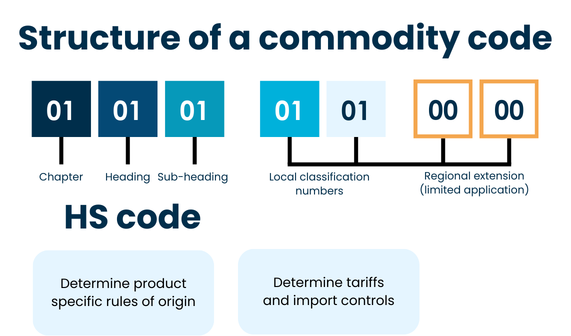
The HS nomenclature is positioned at the foundations of trade negotiations, product-specific rules of origin, and monitoring of trade flows and statistics. Governments extend the HS at the regional level, and use it to apply indirect taxation, protectionist measures, as well as restrictions related to the import and export of goods.
The general rules for the interpretation of the harmonised system (GIR) provide legal guidance on how to interpret the HS. They ensure that all customs authorities and traders use the same logic when determining how products are categorised for import, export, and tariff purposes.
The commodity code is a number submitted to customs authorities that identifies the goods in accordance with regional interpretation. For imports, this is generally a ten-digit code. For exports, this is usually an eight-digit code. The HS harmonises the first six digits of this code on a global basis. For imports, the final four digits of a commodity code, concerning the regional classification nomenclature, is a frequent cause of challenges, due to varied interpretations across global markets.
Tariffs, regional prohibitions, and restrictions are usually established at the eight- or ten-digit level, rather than the six-digit HS code which determines access to product-specific rules of origin.
The careful execution of tariff classification at the regional level should be prioritised for organisations that frequently move goods between borders. At the regional level, the local administration will publish explanatory notes, particular to domestic interpretation.
Incorrect tariff classification
A key cause of incorrect tariff classification is the regional variations which occur within the final four digits of a ten-digit classification for imports. For instance, a multinational enterprise sourcing suppliers across multiple regions, such as Japan, China, India, the UK, France, and Italy, may ship to their stores or e-commerce fulfilment centres in the US.
In order to do this, they are likely to request a commodity code from their suppliers, which they can include against their inventory, within their centralised enterprise resource planning (ERP) system.
It’s critical for the ERP system to distinguish between regional variations in tariff classification, and apply the appropriate commodity code in accordance with the jurisdiction of the importing country.
A commodity code provided by a supplier in the UK, Italy or India may have a different meaning as interpreted by the US Harmonised Tariff Schedule (US HTS), than it does in the exporting country. In parallel, a commodity code provided by a supplier in the US may be interpreted differently when applied to an import entering the UK, Italy or India.
Working recently for a global luxury menswear brand, the reclassification of over 90% of the brand’s inventory was required for the US market, due to regional variations between European and US commodity codes.
For example, a men’s fine woollen suit is classified as 6203110000 within the UK and the European Union (EU). However, if it was exported to the US with that code, it would be held up at the border. The questions asked by US customs authorities related to regional classification would be to make a selection as follows:
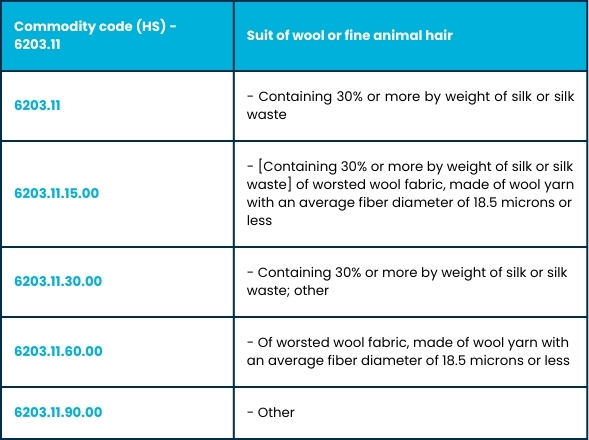
The delay could cause demurrage – a fee levied where goods are not cleared and moved on a timely basis. Another common issue that could occur is that the freight-forwarder might be asked to make a decision on behalf of the importer.
If the classification is later questioned by the customs authorities, without sufficient knowledge of the product, an ill-informed decision could lead to a post-clearance demand note for unpaid duties being issued to the importer. For large companies trading on a daily basis, incorrect classification may pose a significant financial risk.
For suppliers managing the international movement of goods and their cost efficiency, it’s crucial to execute a robust tariff classification roadmap that reduces friction at the border and boosts profitability.
Whether using tariff analysts or artificial intelligence (AI), or a combination of both, it’s essential to provide reliable, in-depth product descriptions which acknowledge jurisdictional classification requirements.
The strategic implementation of a tariff classification roadmap requires the following:
Phase I: Set up tariff classification planning
Setting up a tariff-classification framework should begin with the creation of a centralised inventory covering all goods that are purchased, sold, transferred, or otherwise moved internationally.
This inventory should be supported by a detailed mapping of supply chains and shipment flows, including:
- Intra-company
- Inter-branch
- Third-party logistics
You may then identify where tariff-classification and customs obligations arise and review commodity codes for both imports and exports. Make sure to take into account relevant national and regional subdivisions, such as the Combined Nomenclature (CN), the UK Global Tariff, and the US HTS.
Assess export controls and dual-use classifications across all jurisdictions to ensure compliance with security- and technology-related restrictions, and assign internal ownership and escalation routes, including when external classification rulings or customs brokers should be consulted.
Apply document classification methodology, such as an analysis of GIR, notes, rulings, and precedents. Establish version control and change management procedures for classification updates.
Phase II: Gather and analyse data and provide key insights
The next stage involves applying the GIRs systematically to determine the classification of each product.
Create and maintain commodity files containing:
- GIR reasoning
- Product specifications, technical sheets, and drawings
- Binding Tariff Information (BTI) rulings and advance rulings
- Duty, value-added tax (VAT), excise, anti-dumping, and anti-countervailing measures
Ensure linkage between tariff codes and taxation, including:
- Duty and VAT rates per jurisdiction (where applicable)
- Excise liability (where relevant)
- Implications for customs valuation, transfer pricing or product costing
Maintain documentation tracing how each classification was determined, including internal approvals.
Build a data repository to support claims under:
- Preferential rules of origin
- Quota utilisation
- Origin certifications and supplier declarations
Validate supplier-provided codes, ensuring suitability for import into destination markets, using the importing nation’s database, for example, the US HTS, the UK Trade Tariff, or the EU Customs Tariff (TARIC).
Phase III: Define and implement the tariff classification plan
The final phase begins with deploying classification guidance and training across procurement, logistics, engineering, and finance teams. This must be followed by embedding tariff codes into ERP, customs software, and product master data, ensuring alignment across all systems and regions.
Then review supplier documentation, verifying correct tariff codes, origin statements, and compliance with local requirements.
Make sure to monitor regulatory updates, including:
- Commodity code amendments
- Export-control changes
- Trade remedies and sanctions
- National classification notes and explanatory notes
Maintain an audit trail demonstrating classification logic, evidence, and periodic review, and set up a correction and disclosure process for misclassifications, with timelines and responsible teams.
Support Authorised Economic Operator (AEO) compliance, providing:
- Documented methodology
- Internal controls
- Evidence of robust classification practices
Integrate tariff classification with customs valuation and origin, ensuring a coherent end-to-end customs compliance programme.
—
This three-step strategy for the execution of a tariff classification roadmap highlights that at the regional level, extensions to the six-digit HS code required by government administrations may result in misalignment when moving goods on a global basis.
The UK Trade Tariff and the EU TARIC are mostly aligned, subject to regional updates, and local application of areas such as the EU’s meursing codes. However, the US HTS can diverge considerably from other regions at the ten-digit level, and this divergence can cause goods to be held at the border or subject to penalties.
As a general rule, the more a type of good has been processed, the greater the extension of the code. Therefore, sectors such as fashion, footwear, and textiles, as well as machinery and engineering products may be particularly impacted by the national interpretation.