

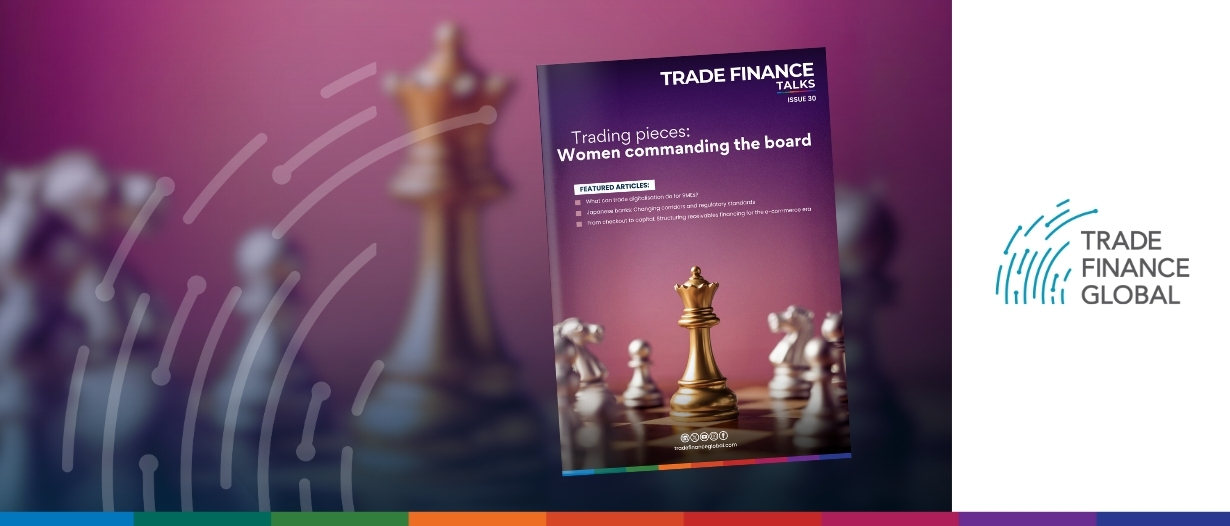

- Trade Finance Global (TFG) commemorates International Women’s Day (IWD) with a magazine authored entirely by women.
- The compilation of high-level thought leadership on industry trends positions women as experts first and foremost.
I introduced the idea of a women’s-only edition to Trade Finance Global (TFG) this time last year. But for this year’s edition, the response has been overwhelming, and Issue 30 is one of our chunkiest yet.
I have a sense that a world which threatens women has resulted in a stronger need to bond together, to reassert the rights and authorities that for decades have been fought for. This is why the United Nations (UN) theme for International Women’s Day (IWD), on Sunday, 8 March, was ‘Rights. Justice. Action. For ALL Women and Girls.’ More and more, these fundamentals are being eroded.
Journalism is not safe. Initially, when the US government announced a rollback in its diversity, equity, and inclusion (DEI) policies, the industry was under some pressure to write without using the words ‘gender’, ‘climate’, or ‘disability’. But how can an independent London-based trade finance publication be governed by the same hands of censorship facing large US legally-exposed equivalents?
This magazine addresses the concerns felt by women in cross-border trade and trade finance over the last year. One conclusion which was made apparent is that women are not underrepresented when you walk into a bank and look around. They are underrepresented on the stage and in client-facing roles.
We’ve recently launched our own events, and are seeing this play out. It honestly was not easy to ensure our inaugural TFG Geneva event had 54%-women speakers. It’s not just that senior roles are dominated by men, and that organisations tend to put men forward for speaker positions, but women tend to be reluctant to speak on stage.
Progress towards inclusion is there, but progress towards visibility is inchcoate.
Section 2 examines the place of women from Latin America and Africa to the UK and Spain; it highlights industry-wide networking and mentorship initiatives; it shares personal testimonies, including of returning to work as a new mother; and it shakes up employment structures – a middle layer of employment redefined by artificial intelligence (AI), or leadership redefined by agility.
At the same time, the sentiment of ‘show and don’t tell’ stands. I have long felt that the best case for women in trade finance is to demonstrate their capability as experts. That’s why the bulk of the magazine explores trends in an increasingly volatile, digital, and accessible world of cross-border trade and its financing.
Section 3 documents what we all assume to be true: that supply chains are shapeshifting and shaking. It examines financial pressures but also solutions, whether that’s weather insurance or audit rights. Most of these are immortal assessments of industry at the time of their writing – but as global contexts change, their conclusions only grow more profound. For instance, a November 2025 article on shadow fleets, which are used to transport sanctioned oil, discusses heightened risk in the shipping industry, and insurers retreating from it…
We talk about digitalisation in Section 4, but mainly from the perspective that something must be done differently. Working capital finance needs to grow more flexible, climate technology needs to align more with corporate targets, electronic records must be collected to empower small and medium-sized enterprises (SMEs), tokenisation should be isolated from hype.
The takeaway from the digitalisation section is that partnership and collaboration are of paramount importance: bank-fintech, payment provider-government, artificial-human intelligence, and every combination in between.
The magazine’s themes are tied together with Section 5, which explores accessibility for underrepresented groups in global trade networks, be these emerging markets, SMEs, or, of course, women. We have the voice of development organisations, law firms, export credit agencies (ECAs), and banks alike. All argue for the transformative role of trade finance instruments and regulation in inciting unified efforts.
But the most important part of this edition is our focus on the IWD.com theme of #GiveToGain. We interviewed two charities changing the world for women: Safer Waves and Sebby’s Corner.
Safer Waves exists to ensure that no one has to face sexual violence at sea alone. Silvia Andreoletti spoke to Jessica Brannan, CEO of Safer Waves, to learn more about the problem.
Seafaring, typically viewed as ‘men’s work’, involves long periods away from home, removed from friends and family, and tends to create environments where colleagues have full visibility and control, as to who you work with and when. These conditions exacerbate sexual abuse, particularly as the industry is so male-dominated. It seems a correlation that would make perfect sense, and by speaking out, the trade industry – which is reliant on maritime networks – can validate victims.
Sebby’s Corner is a longstanding charity partner of TFG, operating so that ‘no child goes without’. I spoke to their Founder and CEO, Bianca Sakol MBE, and learnt about the items most demanded and most donated. In a world of oversupply, donation should be instinctive.
Tariffs, oil price fluctuations, and controversial banking regulations are our modus operandi, but the theme of #GiveToGain allowed me to hone in on why we do what we do – to make the world of cross-border trade a more inclusive one. The exceptional women featured in this edition reinstill faith in the industry’s, and the world’s, future.
Ultimately, the queen is the most powerful piece on a chessboard. Happy reading!