















-
Financial institutions are increasingly adopting ‘always-on’ tokenised trading models to manage liquidity risks during 24/7 geopolitical instability.
-
While banks are generally expected to honour obligations during external shocks, the frequent invocation of force majeure clauses in the Middle East has placed trade contracts under heightened scrutiny.
-
The industry is leveraging artificial intelligence and responsible digitisation to improve real-time risk visibility and provide more secure, efficient capital flows across the EMEA region.
As the European, Middle East, and African (EMEA) regions continue to be plagued by instability, it begs the question: how are financiers managing the increasingly complicated nature of cross-border transactions?
Risk management is tantamount to surviving the pervading crises of ongoing conflict in Europe and the Middle East. Europe, briefly seen as immune to war, has been grappling with the invasion of Ukraine for four years now. The Middle East, an oil and gas goldmine that had recently earned the confidence of foreign investors, is now the poster child for instability.
Operational, legal, and liquidity risks continue to mount for financial institutions (FIs) that are having to deal with the kineticism of trade and trade finance.
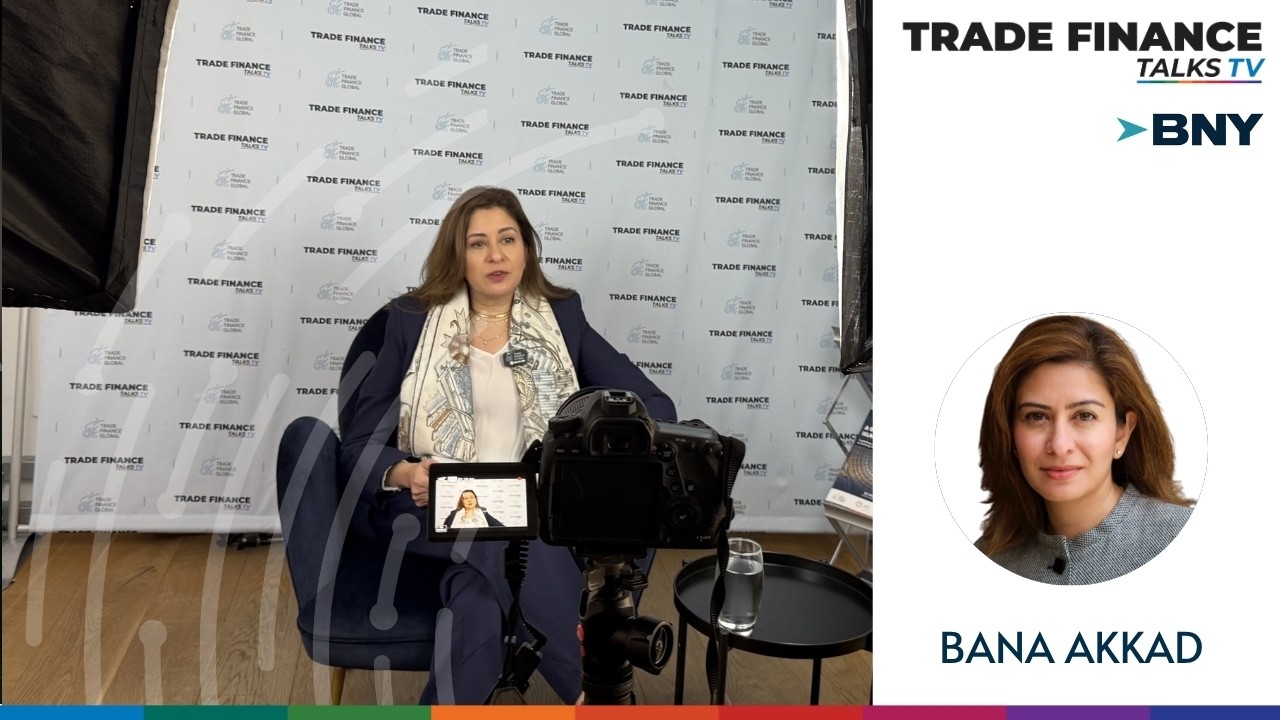
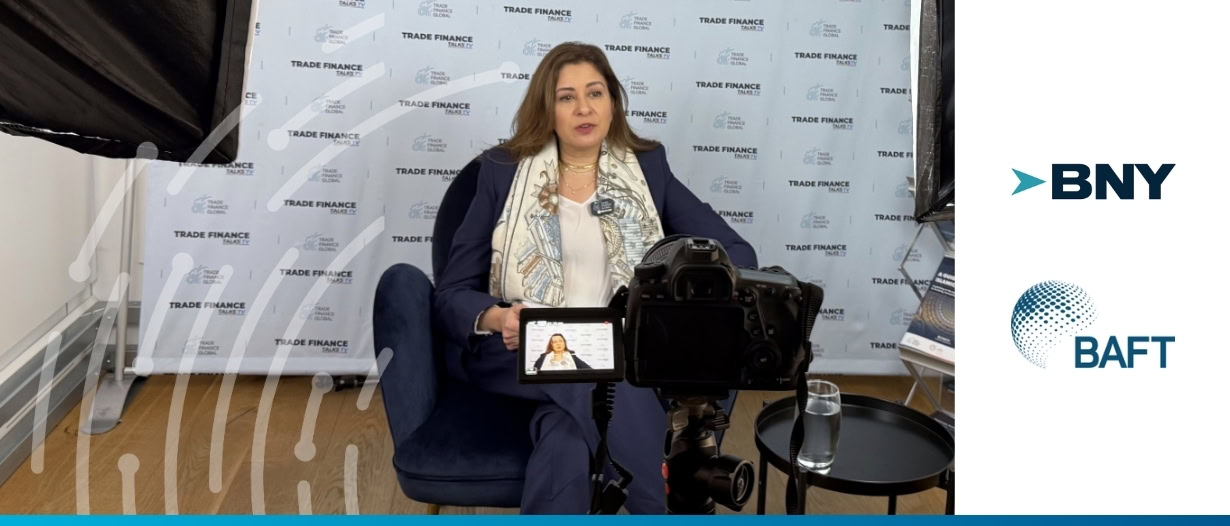
Trade Finance Global (TFG) caught up with Bana Akkad Azhari, Managing Director and Head of EMEA Global Payments and Trade at BNY.
BNY’s relationship with EMEA is, in many respects, foundational. The institution has maintained a physical presence across European and Middle Eastern offices for over 60 years, but its collaboration with regional institutions stretches back considerably further. Among its clients is a Finnish institution whose relationship with BNY dates to 1911. The bank also supported the Ottoman Bank at the turn of the 20th century, and continues to work with successor institutions to this day.
Needless to say, the century following has seen supply chain disruptions of an unprecedented magnitude, particularly in a region as diverse and volatile as EMEA. FIs are consistently valuable to geopolitical shocks as a result of instability, but Akkad provided a clear vision for how the industry can best stay stable.
Novel approaches to liquidity
The war in Iran has created what will undoubtedly be enduring problems with trade flows, particularly through the Strait of Hormuz.
Most of the value of trade that flows across the Strait is tethered to the major economies across the Gulf and Asia, the UAE and China being the biggest players with trade value at stake. They respectively have around $250 billion worth of export/ import value, contingent on trading across the Hormuz.
However, for Akkad, the disruption is “not just to the local economies, but even to the broader economies.”
The scale of disruption is near-incalculable for global trade as a whole. Consider commodities: fertiliser, gases, chemicals, and metals also pass through the Hormuz daily, all goods which are inextricably linked to sectors like agriculture.
“Clients need to find alternative ways to manage risk. Be that on the liquidity side, be that operational risk,” said Akkad.
Increased capital flight from the Middle East, currency depreciation, and rising costs threaten liquidity for many FIs.
Some have turned to less conventional approaches to managing their capital to offset liquidity risks. For example, on Wall Street, recent shocks exposed how vulnerable the traditional, five-day trading windows are when geopolitical events unfold over weekends. Therefore, investors are moving toward an ‘always-on’ model, accelerating the shift to tokenised trading of real-world assets (RWAs).
But this shift creates a new liquidity challenge: in a 24/7 tokenised market, settlement becomes instantaneous. The buffers that ordinarily give banks time to source liquidity disappear, meaning liquidity risk becomes a lot more immediate and acute.
Force majeure – a clause for concern?
Operational risks have also flared. According to Akkad, “documentation deficiencies, force majeure being triggered, and trade routes being disrupted and having to re-route” are significant risks that institutions are juggling to defend against.
The International Chamber of Commerce (ICC) has reiterated its rules in light of prolonged geopolitical disruption. Banks are exempt from documentation deficiencies, be it delay, loss or errors.
However, for many trade contracts, the force majeure provisions only apply if the event directly prevents the bank from being operational. As such, banks have to continue to honour their obligations amid external shocks.
Since the outbreak of the war in Iran, force majeure has been triggered more, bringing contracts under heightened scrutiny. For force majeure to be accurately invoked, there needs to be a distinct differentiation between banking operations being entirely halted or just extremely limited – the latter could be a valid case for or even against it.
QatarEnergy, responsible for a fifth of the world’s liquefied natural gas (LNG) supply, was the first to file. However, publicly invoking force majeure can make matters worse down the line, as it can prematurely signal even greater instability and encourage similar market behaviour.
In this environment, banks see their role as a steady lifebuoy. “That requires a great deal of commitment and flexibility from their partners to stand by them,” Akkad noted.
Forward-thinking digitisation
If geopolitical instability has been the stress test, digitisation has, for a large part, been the rebuilding with stronger materials. Across EMEA, the drive towards faster, more transparent, and more efficient financial services has moved from nice-to-have to expectation.
“Clients are demanding faster, more transparent, and more efficient execution of their transactions,” said Akkad. “Innovation, when done in a responsible way that truly fosters proper governance and resilience, can really open up the opportunity to provide tighter settlements and give more surety and certainty to the flow of money.”
The emphasis on responsibility is deliberate. Technology in financial services is not a neutral tool. Applied without adequate governance, it introduces new vulnerabilities even as it resolves old inefficiencies. BNY’s approach, as Akkad Azhari describes it, is to harness innovation in a manner that is simultaneously secure, ethical, and commercially effective – a balance that is easier to articulate than to achieve, but essential nonetheless.
Artificial intelligence (AI), in particular, is beginning to reframe how institutions think about risk assessment, transaction monitoring, and client service. According to the Economist Impact, there are two uses for AI integration in supply chain strategies: operational restructuring and improving visibility through monitoring.
Proactive disruption management and building resilience can come via real-time risk visibility and predictive analytics for supply chain planning, such as improving collaboration across vertical supply chains to better understand how risk operates within their ecosystems.
—
Given the paradoxical nature of risks, it’s up to institutions to think about collaboration “to leverage that added technology, harness it in a way that is responsible, provides true and proper governance, and gives resilience,” said Akkad.
The potential of new financial infrastructure and the complexity of finding potential new risks before they are realised thrusts a new onus on banks.
On the opportunity side, emerging payment rails, enhanced settlement layers, and complementary financial technologies are creating new pathways for capital to move more efficiently around the world. The EMEA region is at the centre of these flows.
“It really opens up a whole myriad of ways we can improve and foster better flow of capital around the world,” she says, “so that it gets to where it needs to be in a way that is very efficient and very targeted.”
Yet the same forces that create opportunity also amplify risk. Banks must place partnership with clients, technology providers, and regulators at the centre of their strategies.