














-
The UN Convention on Negotiable Cargo Documents aims to modernise international trade by allowing goods transported by road, rail, and air to be used as collateral or resold during transit.
-
By enabling the use of goods as reliable collateral, the Convention helps women entrepreneurs overcome traditional barriers to credit and access higher-value global supply chains.
-
The introduction of electronic negotiable cargo documents is designed to reduce administrative burdens and harmonise digital trade standards across multimodal transport journeys.
Imagine a world where goods in transit, regardless of their location, destination, and mode of transport, can be resold in just seconds, with a few clicks, realising their full value. A world where it is easier for importing businesses to access trade finance and for exporting businesses to get paid before their goods reach their destination, and where all stakeholders in global supply chains can work with the same set of reliable data. Thanks to the United Nations (UN) Convention on Negotiable Cargo Documents, this utopian vision is becoming a reality.
The UN Commission on International Trade Law (UNCITRAL) is the core legal body of the UN system in the field of international trade law. Its mandate is to remove legal obstacles to international trade by progressively modernising and harmonising trade law.
Over the last few years, an UNCITRAL Working Group, comprised of government representatives and other stakeholders, developed a convention on negotiable cargo documents. This was in response to the limitations of railway consignment notes, which generally cannot function as collateral or a risk mitigation tool in the context of trade finance.
In December 2025, the UN General Assembly adopted the UN Convention on Negotiable Cargo Documents and authorised a signing ceremony to be held in Accra, Ghana, during the second half of 2026. Once ratified by 10 States, the new Convention will enter into force and bring negotiable cargo documents (NCDs) to the market.
Planes, trains, and trucks
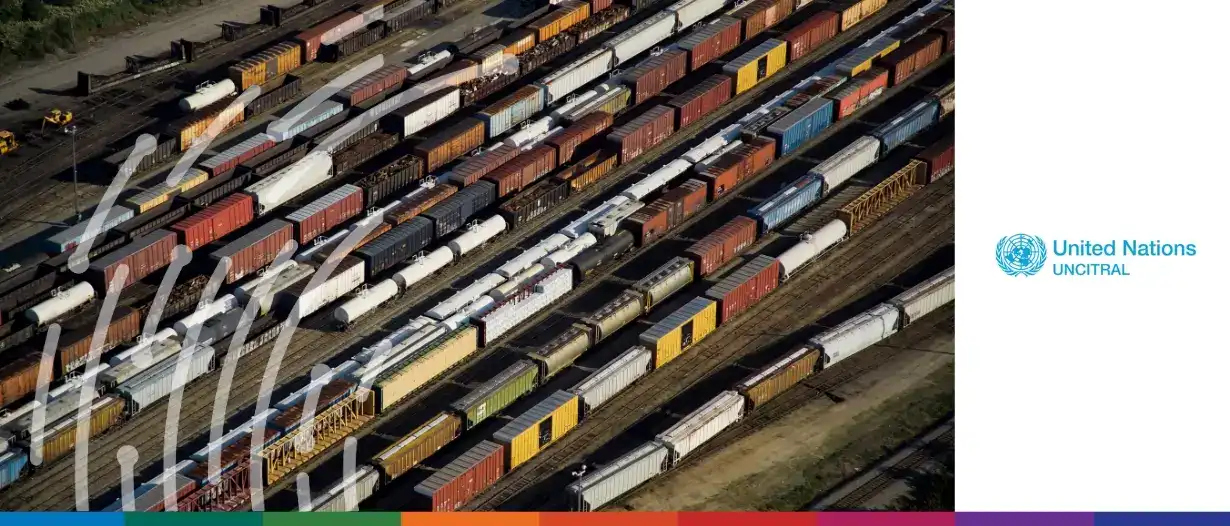
Today, maritime transport already allows goods in transit to be traded or used as collateral through negotiable documents that legally represent the goods. But for road, rail, and air transport, such options have been extremely limited. The new Convention will change this by enabling the use of NCDs across all modes of transport.
More specifically, the new Convention introduces uniform rules governing the issuance and use of NCDs, including their legal effect, as well as the rights and liabilities of NCD holders. These rules aim to promote the acceptance of NCDs by banks and other financial institutions as a credit enhancement tool, thereby improving liquidity and accelerating trade flows. They are also designed to facilitate the sale of goods in transit, which will be music to the ears of commodity traders.
Beyond uniformity and lubricating sales processes, the Convention could enable the use of a single NCD for an entire journey, a revolution given the convoluted systems of varied documentation in multimodal transport. Electronic NCDs, in particular, would facilitate the digital transformation of global trade. The Convention’s provisions enabling electronic NCDs are carefully aligned with the UNCITRAL Model Law on Electronic Transferable Records (MLETR), such that technical standards developed for systems supporting electronic transferable records could be used for systems supporting electronic NCDs.
Key features of NCDs
- Document of title: The transfer of possession of an NCD has the same legal effect as the physical handing over of the goods, for the purpose of acquiring rights to the goods.
- Negotiability: Rights under an NCD may only be exercised by its holder. Third parties acting in good faith are entitled to rely solely on the information that it contains.
- Opt-in mechanism: NCDs are issued only when mutually agreed upon by the transport operator (including any contractual carrier) and the consignor.
- Flexibility: NCDs may be issued in various ways, such as annotations on existing transport documents or as independent, standalone documents.
Roles and benefits
- Transport operators: Any maritime, rail, road, or air carrier may issue NCDs if they conclude a transport contract with the consignor. Freight forwarders acting as a contractual carrier may also issue NCDs, but not when acting merely as an agent.
Issuing NCDs can help transport operators offer customers greater flexibility and more efficient access to global supply chains.
- Consignors: Depending on who arranges transportation, the consignor may be either the buyer or the seller. Buyers (typically importers) benefit from improved access to trade finance; sellers (typically exporters) benefit from the flexibility to resell goods during transit at the time of disruption and across different transport modes.
For example, paper and electronic NCDs have been used as collateral in pilot projects led by the Bank of China for rail and road shipments from Kazakhstan to China. More recently, paper NCDs have been issued in pilot projects arranged by the China Merchants Bank in letter of credit transactions.
New opportunities for women entrepreneurs
As noted in the UNCITRAL Guide on Access to Credit for MSMEs (2023), studies have shown that in many countries, the trade finance gap is likely to be greater for women-owned than for men-owned businesses, a result of cultural biases or economic, social, and legal constraints. For instance, in some countries, women are reported to have less access to affordable credit because they have insufficient credit history or little to no assets to offer as collateral.
The new Convention has the potential to create meaningful economic opportunities for women entrepreneurs – particularly those in landlocked regions. The Convention enables NCDs across all modes of transport, meaning goods in transit can serve as reliable collateral, reducing dependence on traditional assets that women‑owned businesses may lack. As a result, women in trade will be able to secure more affordable credit, opening them up to higher-value supply chains.
The Convention’s support for electronic NCDs is particularly significant for women in remote areas, as digital documentation reduces administrative burdens and lowers transaction costs.
—
Even at the surface level, the Convention is landmark in democratising NCD use in multimodal transport, diminishing complex documentary processes. Digging a little deeper, the Convention can open markets which were once inaccessible by maritime transport, lifting these regions into sophisticated trading systems.
Deeper still, that the Convention allows more goods in transport to be held as collateral means women entrepreneurs, for whom access to credit is a barrier to entry, can be empowered. The utopia described earlier, of uncomplicated and fair trading conditions, is closer than ever.