









-
The Sudanese Armed Forces (SAF) regained control of the country’s only oil refinery by attacking it with chlorine gas, a banned chemical weapon.
-
While Sudan’s domestic oil production is internationally insignificant, the country is a crucial trade route for landlocked South Sudan’s oil exports.
-
Despite accusations of “harrowing” war crimes by both warring parties, there is no blanket ban on gold or oil exports from Sudan.
Few things on this planet are clearly visible from space: the Pyramids of Giza, the Amazon Rainforest, the Himalayan mountain range. Now, pools of blood saturating the ground of Sudan can be added to the list.
The civil war that has been ravaging Sudan for the past two years has grown even more brutal in the past few weeks. With over 150,000 deaths and 12 million refugees, the UN has called it the world’s largest humanitarian crisis. Most recently, a massacre in the city of el-Fasher has caused so many civilian deaths that entire areas of the Saharan desert have been awash in blood.
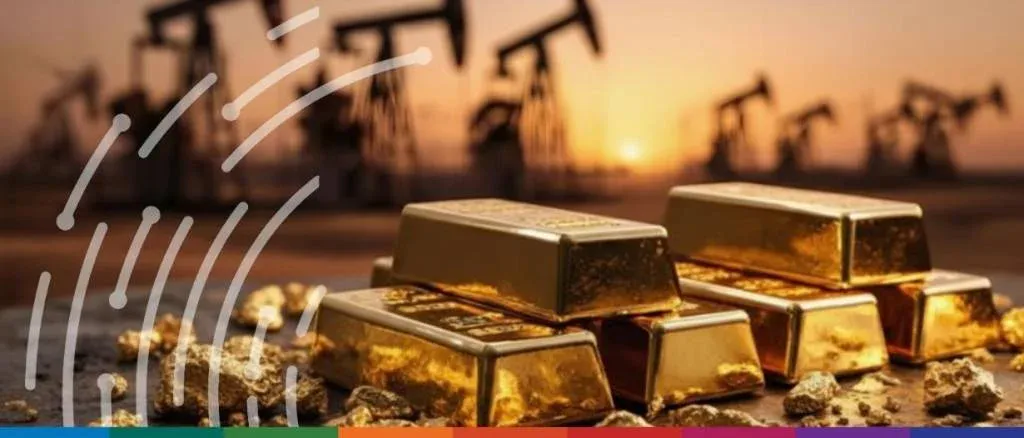
Today, commodity exports in war-ravaged Sudan have reached record highs. The trend falls into the oft-explored “resource curse,” which condemns resource-rich countries – often with a colonial past – to decades of fighting over the dwindling commodities instead of development financed by them.
Sudan’s vast gold reserves – nearly all of which are exported abroad, with the United Arab Emirates (UAE) as the main destination – loom large in the conflict. Revenues from gold exports are “the most significant source of income” for the warring parties, giving the fighters access to much-needed foreign currencies, according to a Chatham House report.
A report by the European Union (EU) found that the RSF militia uses “gold production and exports to secure military support from the United Arab Emirates (UAE), to which most of Sudan’s gold production is smuggled, and from the Wagner Group.” The Sudanese state also relies on the mining sector to finance its production of arms.
Control over Sudan’s gold mines, which generated over $900 million in export revenue from 37 tonnes of gold in the first half of this year, has also been widely reported to be a key motivator of the conflict, as well as financing its bloodshed.
Sudan’s oil production has also played an important role in the conflict, with the country’s only oil refinery being contested between state and militia forces since the start of the war. The Sudanese Armed Forces (SAF) gained back control of the refinery earlier this year by attacking it with chlorine gas, a banned chemical weapon, found the global watchdog Human Rights Watch.
Gold and oil: And no sanctions
Sudan is Africa’s third-largest gold producer, exporting the vast majority of production to the UAE via neighbouring Egypt and Ethiopia. Most of the country’s production is through small, unsophisticated mines, making it difficult to quantify and track production.
The mining industry is practically unregulated and extremely hazardous: a mine collapse in July 2025 killed at least 11 people, while many more suffer from the use of dangerous chemicals in the extraction process. Child labourers are commonplace in the mines, with many of them in a condition of effective slavery.
Sudan’s oil reserves, while less lucrative than its gold mining business, are also responsible for much of its foreign exports. Most of Sudan’s oil goes to Europe or Asia, chiefly Italy, Germany, Malaysia, and China. In August, the UAE banned Sudanese oil tankers from its ports after Sudan cut ties with the country and accused it of arming the RSF anti-state militia, which the UAE denies.
While Sudan’s domestic oil production, at just 70,000 barrels per day in 2023, is internationally almost insignificant, the country is an important trade route for oil. South Sudan, a more significant oil exporter which seceded from Sudan in 2011 after a bloody conflict, is landlocked and relies on Port Sudan to ship its oil abroad. Three pipelines run from South Sudanese oil refineries to the Port Sudan Oil Terminal, generating nearly half a billion dollars a year in transport fees for the Sudanese state, according to a PAX For Peace report.
Both the Sudanese army and RSF militia have been accused by the United Nations (UN) Human Rights Council of committing “harrowing” war crimes. But besides a UN-enforced weapons export ban, no sanctions are currently in place prohibiting exports from Sudan.
In 2000, the UK Parliament proposed a motion of concern on the UK and other European companies’ continued investment in one of the Sudanese oil pipelines, which the motion said “threaten[ed] to perpetuate the Sudanese war,” at the time, one of secession between Sudan and what is now South Sudan. The report called on the government to refuse export licenses to Sudan and pressure the international community to cease the extraction of oil in Sudan until the end of the conflict.
How are importers and global commodity houses financing the war?
In 2023, a Global Witness report found that a range of European banks and investors were financing South Sudan’s oil extraction business, including refineries that export oil via Sudan’s pipelines and port. The EU, UK, and US have sanctioned a growing list of people and organisations since the start of the conflict, many of whom are in the gold mining industry.
An EU report found that the RSF militia “has established complex financial networks using profits from its gold business to fund weapons, salaries and media campaigns, and to gain political support,” while the Sudanese army was also using the mining industry to fund its arms production. However, there is currently no blanket ban on gold or oil exports from Sudan as a whole, akin to those seen on Russian energy exports.
Even if those sanctions were in place, they would be of little use as nearly all the country’s gold is exported or smuggled to the UAE, the world’s second-biggest gold exporter. Sudanese oil and South Sudanese oil exported via Sudan mainly go to Asia, although exports fell dramatically since August when the UAE banned Sudanese oil tankers from its ports.
Currently, the country is unintentionally closing off its own commodity export markets. Sudan’s oil infrastructure is, literally, in the crossfire, and tensions with the UAE cut it off from its most important trade partner. However, if tensions abate and exports resume at normal levels, nearly every dollar of revenue will go towards continuing the bloodthirsty conflict.
Sanctions in Sudan have played a part in the conflict, but, as was seen with the UAE’s oil tanker ban, sanctioning specific people and organisations will rarely be as effective as blanket bans on industries.
When the violence is so extreme – the UN warns it could develop into a genocide – and its tie to commodities exports so blatant, the international export community, and especially regulators, have a responsibility to ensure it is not complicit.