









-
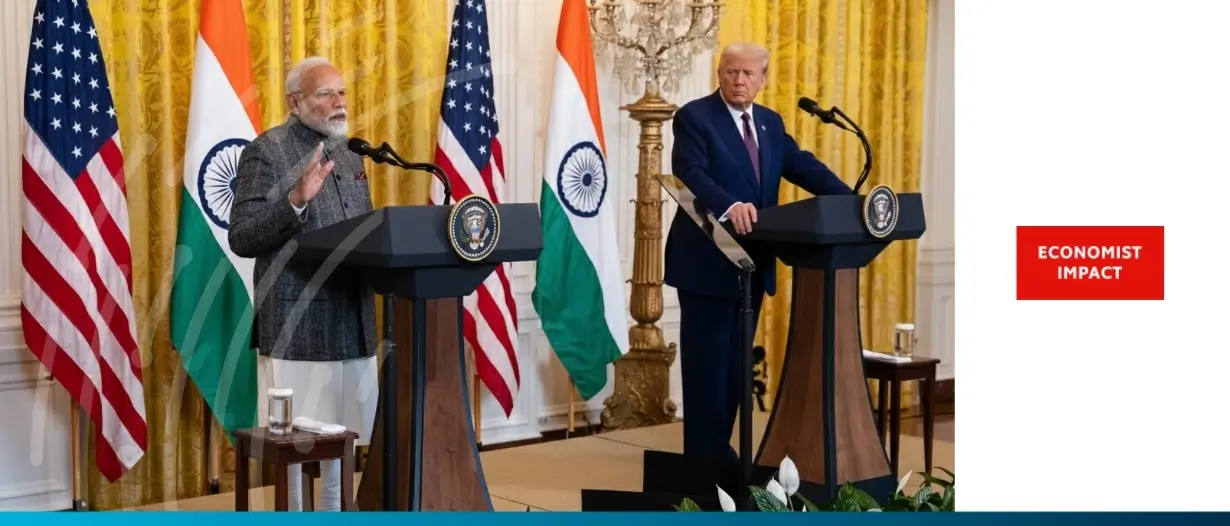
The proposed deal aims to significantly reduce US tariffs on Indian goods from 50% to 18%, while India is expected to purchase $500 billion in American energy and technology products.
-
Despite the potential for economic relief, analysts warn that the unpredictable nature of US trade policy makes long-term supply chain planning difficult compared to the stable framework of the EU-India FTA.
-
While the West seeks to de-risk from China, India is positioning itself to capture a larger share of the global manufacturing market and diversify its energy sources away from Russia.
A US-India trade deal is expected to be finalised, slashing US tariffs on Indian goods from 50% to 18%. The deal, expected to be signed mid-March, would involve India buying $500 billion in energy and tech products from the US, and cutting import tariffs on US goods completely.
However, while US President Donald Trump expects India to replace its purchase of Russian oil with US and Venezuelan oil, Indian authorities have yet to agree.
Trade Finance Global (TFG) heard from John Ferguson, lead of the Future of Trade initiative at Economist Impact. “The US-India deal is welcome news – it will limit inflation damage to the US economy and protect Indian exporters,” said Ferguson.
In 2025, Barclays gave a warning that 70% of Indian merchandise exports to the US were facing a “serious threat,” posing a significant challenge for Indian exporters for whom the US was the single largest market, accounting for 18% of their total exports in 2024.
According to an estimate by Yale University, tariffs introduced in 2025 would translate into an average loss of $3,800 per household in 2024 dollars, reflecting how US consumers were also hit hard by the tariffs.
However, although the deal may come as a relief for many, for Ferguson, it also “exposes how tariffs have become a weapon rather than a trade tool.” Referring to India’s recent free trade agreement (FTA) with the European Union (EU), “India now has two trade templates: the EU-India FTA offers stability and clarity. US-India deals can change overnight, making long-term planning impossible. You can’t build supply chains on shifting sand,” he explained.
The EU-India FTA, signed just last week, made headlines as the single biggest FTA ever seen, creating a free trade zone of over two billion people and lifting access barriers for Indian exporters entering the EU market, and vice versa.
This deal came amid tariff threats by Trump on EU countries that contest his ambition to take “ownership” over Greenland, signalling a move away from protectionist American trade policies by the EU and India.
However, India’s newfound amicability with Trump suggests otherwise. “The weaponisation of trade is dismantling the rules-based system,” said Ferguson. “Tariff threats and last-minute deals are replacing a rules-based framework founded in cooperation and mutual prosperity. Chaos is replacing predictability. What the global economy needs is a return to stable trade where global commerce isn’t subject to geopolitical brinkmanship.”
For Ferguson, the imbalance between India’s stable corridor with the EU and the unreliable one with the US is reflective of “two key trends in today’s global economy: ongoing uncertainty in the US market and rules-based stability in the EU market. These are two very distinct paths that all markets, not just India, need to navigate.”
However, he noted that in spite of the seeming disarray in trade relations, newly signed deals also serve to provide stability for corporates looking to expand their businesses abroad.
The recent US deal is the third of India’s evolving trade relations with major Western powers, after they slashed their tariffs with the UK last year. These deals come amid efforts from the West to reduce its dependence on Chinese exports, as seen by a recent Washington-led summit on rare earths and how to reduce Chinese dominance in the sector.
“India will not replace China as the world’s dominant manufacturer, but it is positioning itself to take a share of this market,” clarified Ferguson. “This trend benefits both the West and India. The West is trying to de-risk from the Chinese market. While not exiting the Chinese market entirely, diversifying away from China to some degree is the desired risk-mitigation strategy.”
“Ensuring the energy security of 1.4 billion Indians is the supreme priority of the government,” said Randhir Jaiswal, India’s Ministry of External Affairs spokesperson. “Diversifying our energy sourcing in keeping with objective market conditions and evolving international dynamics is at the core of our strategy.”
Both India and the US frame the deal as a step toward ending the Russian invasion of Ukraine, with Indian Prime Minister Narendra Modi thanking Trump for his efforts aiming at “global peace.”
Whether India will agree to eliminate its purchases of Russian oil remains to be seen, but as of now, it is certainly diversifying its trading partners and energy suppliers.
“For India, which will remain non-aligned in today’s geopolitically fraught environment, the EU offers a major market for expanding its international presence,” said Ferguson.