





-
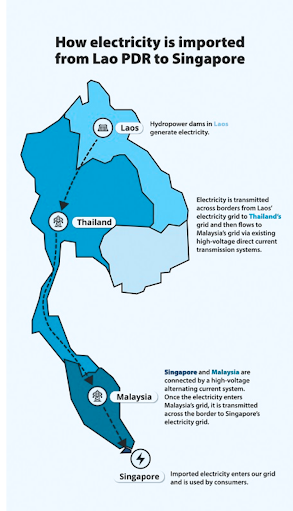
A two-year contract has been signed to resume the import of up to 100 megawatts of hydroelectric power from Laos to Singapore via Thailand and Malaysia.
-
The original agreement lapsed in mid-2024 because of political instability in Thailand following the removal of the country’s Prime Minister.
-
While this project provides only 1.3% of Singapore’s peak demand, it represents a significant move towards green energy for a nation that currently relies on fossil fuels for 92% of its power.
On Wednesday, 14 January, the Malaysian state-run energy company announced it had signed a two-year contract to resume South-East Asian energy trade, reviving an agreement that had lapsed in 2024.
Under the project, electricity produced in Laos will be transmitted across existing links via Malaysia and Thailand to reach Singapore, further integrating electricity production in the region. The project will provide up to 100 megawatts of hydroelectric power produced in Laos to Singapore.
Électricité Du Laos, Laos’ state utility company, will pay Malaysia and Thailand’s energy providers, for the wheeling services needed to transmit the electricity from Laos to Singapore.
While the project’s capacity is only about 1.3% of Singapore’s average monthly peak system demand, it marks an important step towards green energy. Singapore’s power grid overwhelmingly depends on fossil fuels, with only 8% of its demand met by renewable energy sources. By comparison, China has a quarter of its demand met by renewables, while windpower alone met 55% of Danish energy demand in 2022.
The agreement was first signed in 2022 for two years as part of the Lao PDR-Thailand-Malaysia-Singapore Power Integration Project, a regional project intended to promote the use of renewable energy and promote economic cooperation in the region.
However, when the agreement expired in mid-2024, it was not renewed due to the political turbulence in Thailand, according to Malaysia’s energy minister. This refers to the removal of Thailand’s Prime Minister by the Thai Constitutional Court in August 2024.
Source: Singapore Energy Market Authority