











- The UK and Japan have renewed their partnership on critical minerals and cybersecurity to strengthen supply chains and reduce reliance on China.
- The alliance comes ahead of a Washington summit where G7 countries will focus on rare earths, which are vital to manufacturing and currently dominated by Chinese processing.
- Japan’s recent deep-sea rare earth discovery and existing agreements like the Hiroshima Accord underline a broader push by like-minded countries to de-risk from China.
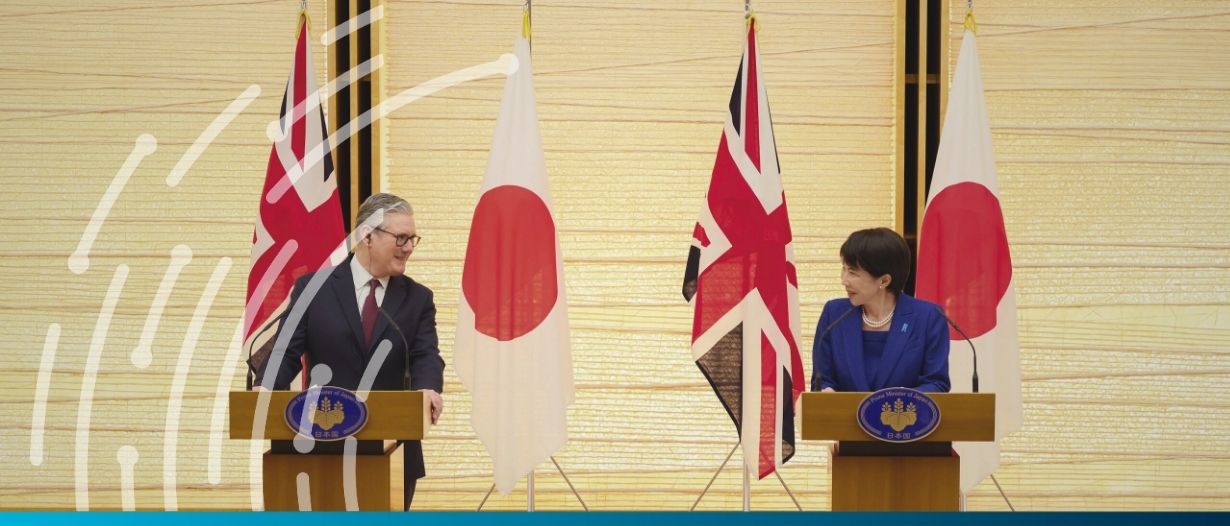
The prime ministers of Japan and the UK have announced their renewed partnership over critical minerals and cybersecurity following a meeting in Tokyo on Saturday, 31 January.
The statement comes as 20 countries, including the Group of Seven (G7), prepare to meet tomorrow, Wednesday, 4 February, in Washington to discuss their cooperation on critical minerals.
The upcoming summit is framed as an opportunity to de-risk from China, as well as for the US to mend what have become fraught transatlantic trade partnerships.
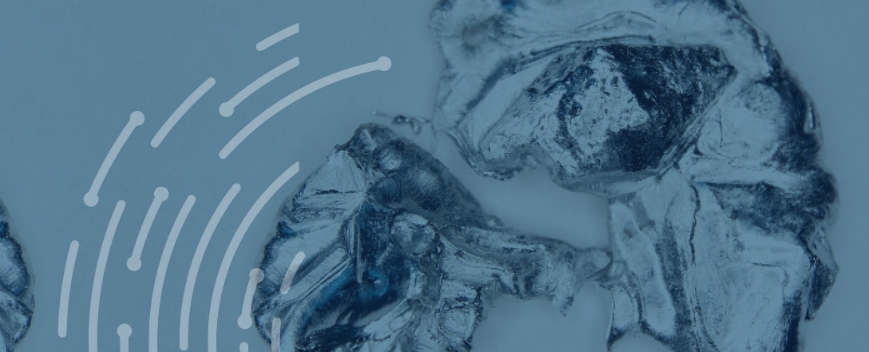
A focus of Wednesday’s meeting will be rare earths, 17 heavy metals which are essential in manufacturing. Rare earths are essential to manufacturing, in fields ranging from wind turbines to missiles.
China is home to over 44 million tonnes of rare earth deposits, over a third of the global reserves. Crucially, China controls 92% of global rare earth processing.
In a deep-sea test mission in the Pacific Ocean earlier on Monday, Japan announced its retrieval of sediment containing rare earths from depths of 6,000 metres. This discovery should facilitate Japan’s move away from China in terms of rare earth production.
On their newly reignited partnership with Japan, UK Prime Minister Keir Starmer said, “We are both proud trading nations, so we have a clear interest in maintaining free and predictable trade and a free and open Indo-Pacific to ensure our businesses can thrive in a turbulent world.”
Echoing Starmer’s sentiment, his Japanese counterpart, Sanae Takaichi, emphasised that “like-minded countries” must work together to build supply chain resilience.
The UK and Japan have a longstanding alliance on critical minerals, beginning in October 2023. The commitment, formalised as the Hiroshima Accord, was signed to strengthen cooperation on research and innovation, data and traceability, industry partnerships, and environmental, social, and governance (ESG) standards.
The upcoming Washington summit marks a move toward reducing dependency on China for rare earths and diversifying supply chains. In 2025, China accounted for 99% of the European Union’s (EU) supply of rare earths: to the extent that the EU accused China of “weaponising” its abundance of raw materials.
China introduced new controls in the past year, making it mandatory for foreign companies to obtain licensing from China before exporting both Chinese-sourced rare earth materials and products that contain Chinese-sourced rare earths.
Therefore, minimising dependency on China remains a key motive for many countries when approaching this summit. In spite of ongoing tensions due to US President Donald Trump’s tariffs, the US appears as an active member in building a critical minerals alliance.
“Strengthening critical mineral supply chains with international partners is vital for the US economy, national security, technological leadership, and a resilient energy future,” said the US State Department.