






-
Prime Minister Mark Carney is collaborating with the UK to establish the Defence, Security, and Resilience Bank to finance and secure international supply chains.
-
Canada intends to reduce its reliance on the United States by allocating 70% of its military spending to domestic manufacturers and increasing its defence budget to 5% of GDP.
-
The Canadian government is actively diversifying its trade portfolio by pursuing deeper agreements with the EU, the CPTPP bloc, and China.
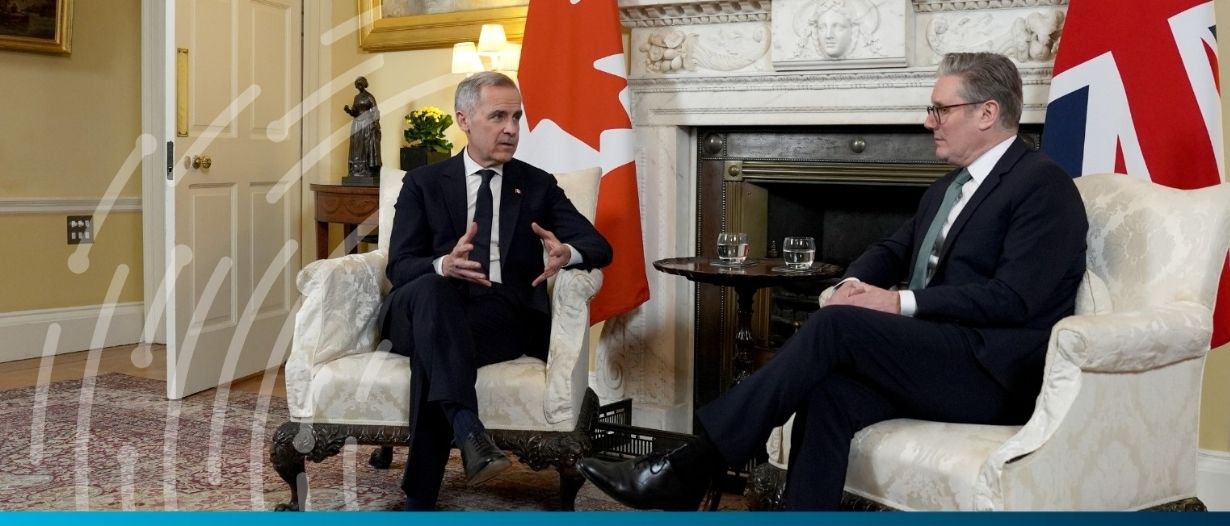
On Monday, 16 February, Canadian Prime Minister Mark Carney discussed deepening UK-Canadian trade and security relations with his UK counterpart Keir Starmer. This comes amid ongoing talks about a potential trade alliance between the European Union (EU) and the Comprehensive and Progressive Agreement for Trans-Pacific Partnership (CPTPP) bloc, which includes both Canada and the UK.
A statement published by Carney’s office highlighted Carney and Starmer’s shared efforts toward forming the Defence, Security, and Resilience Bank (DSR Bank), a multilateral bank owned by nation-states, aimed at financing defence and security supply chains.
This alliance is emerging as Canada diversifies from its southern neighbour, moving away from US defence manufacturers and replacing them with domestic ones by committing to increasing military spending to up to 5% of its GDP, in hopes of creating 125,000 jobs.
Historically, the US has been Canada’s biggest defence partner, responsible for 70-75% of Canadian weapon imports. With this new policy, the Canadian government will dedicate 70% of its military spending to domestic manufacturers, aiming to increase arms exports from Canada by 50%.
This focus on defence supply chains amplifies the global buzz around critical minerals, with a recent Washington-led summit focusing on how to de-risk from China on the matter. 12 critical minerals, including aluminium, beryllium, and cobalt, are deemed crucial raw materials for weapons manufacturing by the North Atlantic Treaty Organization (NATO).
Canada’s revised military-spending strategy was also announced a few weeks after Carney gave a speech during the World Economic Forum (WEF) in Davos, condemning US President Donald Trump’s “rupture” of the rules-based international order and urging the global “middle powers” to unite in response to the US’ hegemony.
Forging new partnerships
Carney and Starmer’s meeting addressed the potential partnership between the EU and CPTPP, a free trade bloc that includes Mexico, Australia, Brunei, Chile, Japan, Malaysia, New Zealand, Peru, Singapore, and Vietnam, alongside the two states.
The deal could bring together almost 40 countries with a shared framework on the rules of origin, as well as a low-tariff agreement, significantly easing barriers to trade.
Canadian delegates also headed to CPTPP-member Mexico this week, on a mission to discuss a new trade agreement. Existing Mexico-Canada trade agreements include the United States-Mexico-Canada Agreement and the Trans-Pacific Partnership (TPP), both of which involve the US.
The Canadian Chamber of Commerce is planning to increase its engagement with Mexican businesses as well: “Today, only 1,1% of Canada’s exports go to Mexico. As Canada works to diversify its global trade, deepening our business relationships with Mexico is not just logical – it’s essential,” said its President and CEO, Candace Laing.
Ottawa has also been in discussions with Beijing to come to a trade agreement. The deal would involve Chinese tariffs on Canadian canola seed lowering from 84% to around 15% by 1 March; and would cover steel and aluminium, commodities that are heavily-tariffed by the US. In tourism, China has allowed visa-free travel for Canadian citizens. Canada also aims to increase its exports to China by 50% by 2030.
Collaboration between the two countries has incited a strong reaction from Trump, who has implemented a 100% import tax on Canadian goods, as a result of the proposed Canada-China trade deal.
Trump’s reaction comes as relations between the two countries have been on an upward trend in general.
—
A recent study analysing United Nations (UN) voting patterns revealed that the world is now more closely aligned to China than the US when it comes to diplomacy, demonstrating how the number of countries aligned with the US has declined from 46 when the Democrats were in office, to just seven during Trump’s latest term.
This signals that Canada’s recent trade and security moves are driven by a desire to retreat from its deep-rooted partnership with the US, reflecting a new era for the maple middle-power and a shifting trajectory for the northern half of the continent.