













Listen to this podcast on Spotify, Apple Podcasts, Podbean, Podtail, ListenNotes, TuneIn
-
The traditional rules-based global trade order is fragmenting amid rising great power rivalry, with trade and supply chains increasingly used as tools of coercion rather than cooperation.
-
Trends such as friendshoring, friendvestment, and de-dollarisation are accelerating financial and economic fragmentation, risking significant losses to global GDP and employment.
-
Despite these pressures from geopolitics, climate change, and AI, countries are seeking a new, more regional and pluralilateral rules-based trade system rather than a complete collapse of globalisation.
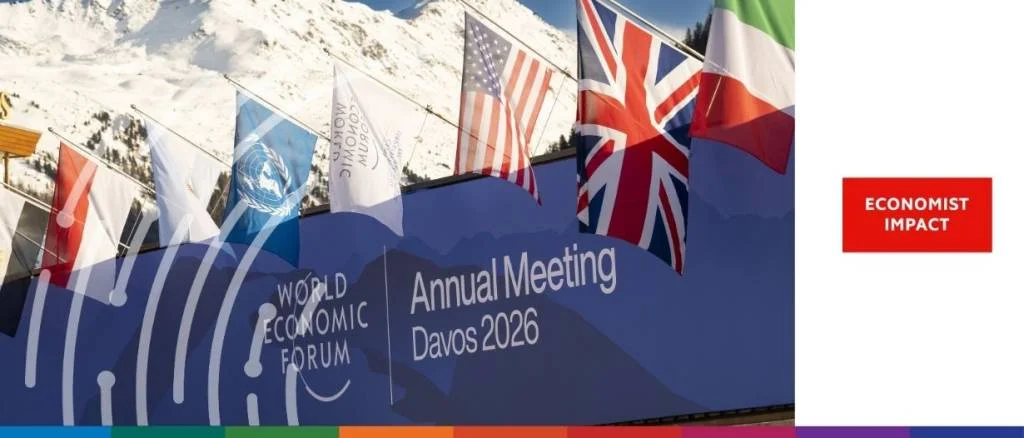
Tensions have been high at this year’s World Economic Forum (WEF) held in Davos, Switzerland. The tone was set from Canadian Prime Minister Mark Carney’s proclamation on Tuesday, 20 January, that “the rules-based order is fading”, for which he received a standing ovation.
Carney’s speech urged leaders to look at the reality of the rules-based international order, saying: “Call it what it is – a system of intensifying great power rivalry, where the most powerful pursue their interests, using economic integration as coercion”.
It’s a speech that, according to John Ferguson, the Global Lead of the Economist Impact’s New Globalisation practice, “everyone here is talking about”.
Trade Finance Global (TFG) spoke with Ferguson live from Davos, and asked him all the ‘W questions’ which have been descending in full force: whether and when traditional global trade broke, how, why, and what comes next.
Is the rules-based international order over?
“The global trade order, as we’ve become used to it, is collapsing”, Ferguson told TFG.
On Wednesday, US President Donald Trump stood in front of thousands of business and political leaders and reiterated his desire to take “ownership” of Greenland, a territory of the Kingdom of Denmark. While Trump later clarified he would not use military force, the remarks struck a significant blow to the integrity of an already shaky North Atlantic Treaty Organization (Nato).
Since this speech, Trump has scaled back his coercive threats of tariffs on European counterparts – but not before these threats reignited the fear born on Liberation Day: that the interconnected nature of supply chains can leave countries exposed, potentially making trade a source of conflict.
“We didn’t quite get trade right over the last 10 to 20 years,” conceded Ferguson.
The hyper-globalisation and liberalisation of the 1990s saw supply chains and trade rapidly expand worldwide, accompanied by the belief that increased trade would discourage conflict.
However, Ferguson explained that: “When an economy opens to trade, overall, the benefits outweigh the losses, but there will be some losses. And we didn’t, with hindsight, do enough to deal with those who suffer from dislocations in certain geographical areas”.
Now, these dislocations have increased fragmentation in international commerce, fracturing an existing economic world order.
Evidencing divisions
Several growing trends point to a shift away from the traditional liberal, interconnected, and globalised economy.
The first, “friendvestment”, coined by Economist Impact, describes a shift towards investment which seeks to avoid geopolitical risk in supply chains, customers, and operations. Instead, institutional investors choose to pour capital into jurisdictions where geopolitics are less intrusive – essentially, hedging against risks.
Friendvestment complements another growing trend, “friendshoring,” which sees companies deliberately shifting their supply chains to countries regarded as political and economic allies.
The problem, as Ferguson explains, is that a world in which companies do business only with their “friends,” thereby reducing cross-border capital flows, can lead to significant financial fragmentation.
A report from Economist Impact and Swift, released in February 2025, warned that if financial fragmentation continues at the current rate, by 2030, there could be 280 million fewer jobs and global GDP 6% lower than in the absence of this fragmentation.
Another growing trend is de-dollarisation, particularly among the BRICS alliance, composed of Brazil, Russia, India, China, South Africa, and five other nations. Together, these countries account for around 45% of the global population and 35% of global GDP.
The shift among BRICS countries away from the dollar reflects both their dependence on the currency, which leaves them exposed to global trends, and a growing lack of trust in the US dollar globally.
However, Ferguson highlighted another, more worrying concern for global business at Davos. He noted that “there is a genuine concern, emanating out of US behaviour, about an attack on the Federal Reserve”, which would impact bond and currency markets.
The lack of faith in US institutions is undermining global confidence in the US dollar as a trusted global asset in an unprecedented way. It also reveals a shift by BRICS away from a shared global basis for exchange.
Climate change, AI, and a fractured globe
The Economist Impact have identified three key areas causing fragmentation. Alongside intensifying geopolitical competition, there is rapid technological acceleration through artificial intelligence (AI) and escalating climate disruption. These trends are similar in the distance they create between developed and developing countries.
Climate disasters are occurring more frequently, leaving trade and supply chains increasingly vulnerable to fires, flooding, and other natural disasters. The impact is heightened in emerging markets, which often lack the necessary infrastructure, leaving them exposed to climate risks and at a greater disadvantage in procuring the essential investment needed to build and rebuild.
Similarly, the benefits of AI have so far been primarily concentrated in the West and developed nations, which could further dislocate developing markets.
This trend is particularly concerning for countries where AI developments, such as the call-centre industry in India, are directly replacing labour. Investment bank Jefferies predicted that India’s call centres would face a 50% revenue hit and other back-office jobs a 35% revenue hit over the next five years due to AI adoption.
The same trend holds for youth, with the widespread deployment of AI displacing the jobs of many young professionals. In the UK, the King’s Trust found that 10% of jobs held by young people were likely to be displaced by AI, 300,000 roles in real terms.
In addition to these areas, Ferguson pointed out the under-examined potential of AI to dislocate a third group of people: older adults. If there are significant advances from AI in terms of health, Ferguson explained, “people could be living to 90 or 100, but there is no way that people can be retired from the age of 62 or 65. Our governments, our public systems can’t support that.”
It’s not just geopolitics that has the potential to destabilise the world. Climate change and technological revolution could widen the economic development gap, fracturing the world along geographical, social, and perhaps age lines.
Where does this leave globalised trade?
The world has survived geopolitical ruptures, technological revolutions, and climate events before. Ferguson argues that the confluence of the three “explains the disruption and the chaos and the uncertainty” we are experiencing today.
But a new order may be emerging.
On 17 January 2025, the EU and four Mercosur countries, Argentina, Brazil, Paraguay, and Uruguay, adopted the EU-Mercosur Partnership Agreement (EMPA) and the interim Trade Agreement (iTA), which will drive an estimated 39% annual increase in annual exports to Mercosur, to the value of €49 billion. Ferguson suggested Trump’s approach to international trade had pushed the agreement, which had been 20 years in negotiation, over the line. This is the trend which has dominated regional free trade agreements in the last year – and is only set to escalate.
The rest of the world, essentially, is “trying to find new ways of regional partnerships, regional trade agreements, pluralateralism,” said Ferguson, suggesting that countries were moving towards a different, new, but still rules-based order.
—
As part of its effort to build a new trade system, Economist Impact launched a new Future of Trade initiative on Thursday at Davos. The multi-year initiative outlines a roadmap to address fragmentation caused by geopolitical tensions, rapid AI and automation growth, and the onset of climate disasters.
The project seeks to build consensus and establish a blueprint for progress through dialogue and the provision of evidence-based insights to decision-makers, amid an increasingly volatile trade environment.
Ferguson said, “If we continue going down this fragmented path, we’re all going to lose. But that’s a choice. We don’t have to make that choice.”