



- Tariffs are becoming a political tool, creating uncertainty and disrupting commodity trade margins.
- The EU’s sustainability regulations impose compliance burdens on traders, even beyond European borders.
- Bond market turbulence presents an increasing risk for commodity traders who rely on credit markets for financing.
Commodity traders are heading into the new year facing a risk landscape that’s more political, more complex, and far less predictable than anything the market has seen in years. As tariffs morph into geopolitical leverage, sustainability rules create under-the-radar compliance burdens, and volatility becomes the norm, traders are being pushed to rethink the tools and strategies they rely on.
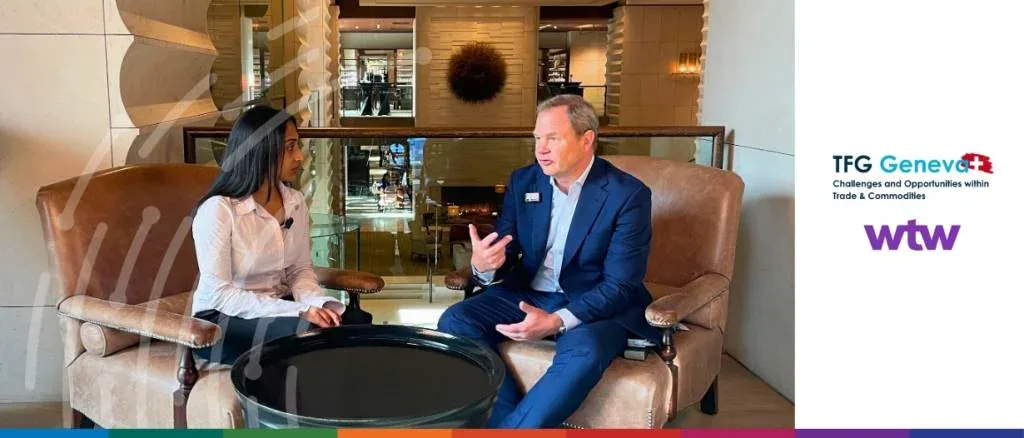
On 6 November, Trade Finance Global (TFG) hosted its first international conference, ‘TFG Geneva: Challenges and Opportunities within Trade & Commodities.’ Held in Switzerland’s global commodity hub, the event brought together senior figures across the sector, including Andrew van den Born, Managing Director and Global Head of Structured Credit and Political Risk at Willis, a WTW business.
TFG sat down with van den Born to unpack the risks faced by commodity markets today – not just the headline challenges, but also the quiet, emerging pressures many in the industry still overlook.
Major risks: Tariffs on top
A recent Willis report identifies the five biggest economic risks currently faced by the commodity trade market: tariffs, China’s economic risks, complications created by a changing climate, the war in Ukraine reshaping energy and agricultural flows, and maritime disruptions increasing transit challenges.
But for van den Born, tariffs stand above the rest: “We will continue to see issues arising from tariffs well into 2026. A single-digit levy can significantly impact margins.”
Commodity trading usually runs on very thin margins; traders make only a small profit per tonne and rely on high volumes instead. So even a small tariff, just a few percentage points, can wipe out most of that profit.
But the implications of tariffs go beyond simple financial hits. “Tariffs aren’t just being used as a means of raising revenue, but are becoming a political leverage tool, which creates a huge degree of uncertainty,” said van den Born.
Recent foreign policy developments reflect this phenomenon. In the US, for example, tariffs have repeatedly served political aims and been used as bargaining chips, often to pressure for changes along the US-Mexico border and in trade behaviour from Canada and China. It’s got to the stage that France’s President Emmanuel Macron has also described tariffs imposed by major economies as a form of “blackmail”.
For commodity traders, this politicisation of tariffs means decisions can shift abruptly according to geopolitical shocks, rather than being based on economic logic, which makes it harder to forecast costs, plan shipments, or protect already-thin margins.
EU regulations: An under-the-radar risk
Not all risks are as visible as tariffs or geopolitical tensions, though. Van den Born highlighted two quieter but increasingly consequential pressures: the European Union’s (EU) sustainability regulation and bond market turbulence.
“The EU is primarily a demand market as far as commodities are concerned, and the application of these regulations will have compliance implications upstream,” he said.
The EU’s Critical Raw Materials Act (CRMA), for instance, is reshaping how essential minerals like lithium, cobalt, and rare earths enter the bloc. Although it aims to ensure access to a secure and sustainable supply of critical raw materials, it also introduces stringent sourcing, processing, and traceability expectations outside of the EU.
“It creates a degree of uncertainty in terms of complying with regulations,” said van den Born. Traders face higher compliance costs, new certification requirements, and potential disruptions if suppliers can’t meet the standards.
The EU’s Deforestation-Free Products Regulation (EUDR) is another example. It requires that all products imported into the EU be fully traceable and proven not to have contributed to deforestation, covering commodities like cattle, cocoa, coffee, palm oil, soy, and timber. It must collect detailed data, conduct due diligence on suppliers, and ensure compliance across complex, international supply chains, which many are viewing as cumbersome operationally.
As van den Born mentioned, while these are EU regulations, they are largely being adopted in other geographies as well. Because of the so-called ‘Brussels Effect’ – where EU rules become widely accepted global standards – these regulations don’t just affect companies exporting directly to Europe. Suppliers and traders outside the EU are increasingly embracing the same compliance practices to maintain access to the bloc, and although this may have immense environmental benefits, it also means the regulatory burden and uncertainty ripple far beyond European borders.
Bond market turbulence
The second under-the-radar threat van den Born pointed to was bond market turbulence: specifically, dislocation and tightening liquidity in global credit markets.
Bond markets are a critical source of financing for commodity traders, who often rely on short-term borrowing to buy, ship, store, and hedge huge volumes of goods. When these markets become volatile, borrowing can suddenly become more expensive or harder to access.
Following the market shocks caused by the Russian invasion of Ukraine, this vulnerability became clear. According to a 2023 report by the Financial Stability Board (FSB), the extreme price swings in commodities during the early months of the war triggered a spike in margin calls, sharply increasing traders’ demand for liquidity.
For a sector so dependent on reliable financing, any instability in bond markets becomes a wider industry risk. When liquidity tightens or borrowing costs rise, traders face greater uncertainty around how and when they can access capital – making it harder to manage working-capital needs during periods of market stress.
Risk mitigation in a volatile market
As traders look for ways to navigate this uncertainty, van den Born argues that resilience can be achieved through optionality. This means incorporating flexibility into every part of the supply chain, whether through securing alternative suppliers, holding additional tonnage, or having the ability to switch the origin of goods when there are chokepoints in supply routes.
Alongside operational flexibility, “all commodity traders need to have a robust risk management framework,” said van den Born. “Traditional products such as trade credit insurance (TCI) and political risk insurance (PRI) still play a very important part.”
But there are also innovative risk mitigation strategies emerging to support traders. Van den Born highlighted mark-to-market insurance, which helps protect traders when the value of their assets fluctuates sharply. He also pointed to trade disruption insurance (not entirely new, but increasingly relevant), which covers lost profits or additional costs when traders are forced to source alternative suppliers or reroute shipments due to unavoidable events or political risks.
Taken together, these strategies reflect how the commodities trade industry is building the flexibility and protection needed to operate in a permanently volatile environment, proactively rather than reactively.
—
“The commodity market still thrives on volatility to a degree,” van den Born said. Reflecting on periods of severe disruption like the COVID-19 Pandemic and the initial invasion of Ukraine, he noted how traders were able to capitalise on sharp price movements. “Volatility ultimately rewards scale, optionality and book optimisation,” he emphasised.
However, he highlighted how while traders may seem to navigate – and even benefit from – market swings, the bigger challenge that lies ahead is policy risks. As governments increasingly use tariffs, sustainability rules, and geopolitical leverage to shape global trade, unpredictability is shifting from markets to regulation.