

















- Swift’s blockchain-based ledger will enable real-time, 24/7 cross-border payments, laying the groundwork for future payment interoperability by 2050.
- AI is being used to predict liquidity needs and facilitate data sharing without compromising privacy.
- Electronic bill of lading (eBL) adoption is still below 50% as of late 2024, despite significant cost-saving potential.
At the 2025 Swift-organised Sibos conference in Frankfurt, Germany, tokenisation, digital assets, stablecoins, and artificial intelligence (AI) were top of the industry agenda. Paradoxically, these ideas often seem a world removed from an industry where paper-based documentation, particularly bills of lading, has remained the dominant form for transactions over the last quarter-century and beyond. By 2050, could we achieve a fully interoperable global payment ecosystem, where any digital asset, currency, or network can interact seamlessly? If so, how?
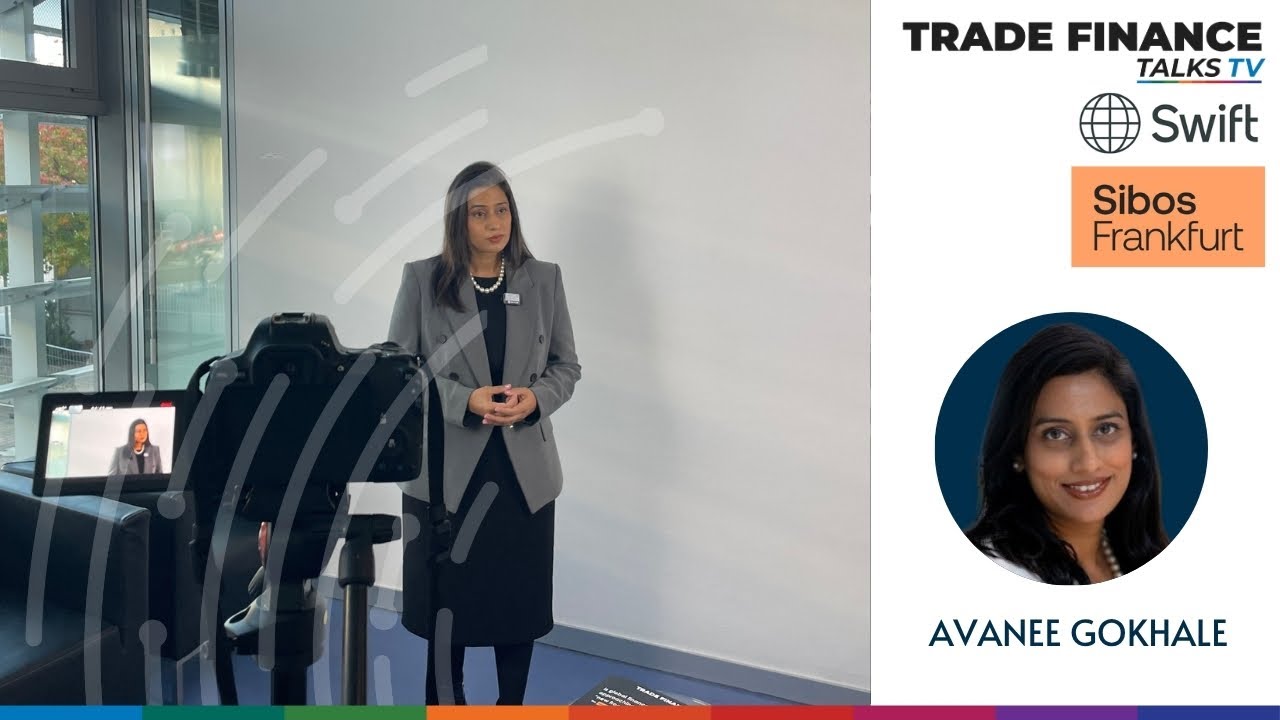
During Sibos, Trade Finance Global (TFG) sat down with Avanee Gokhale, Global Head of Trade Strategy at Swift, to discuss how creating interoperable platforms is key to facilitating a transition away from paper-based documentation toward digitisation and how – or whether – it can build greater industry resilience over the next quarter century.
Enabling decentralised finance
On 29 September, Swift announced plans to add a blockchain-based ledger to its existing infrastructure to enable the real-time 24/7 provision of cross-border payments.
Plans to move towards distributed ledger technology, colloquially known as blockchain, are part of a broader industry trend called decentralised finance (DeFi). DeFi uses financial services to replace or augment existing financial systems by facilitating peer-to-peer transactions without requiring third-party intermediaries. The blockchain ledger envisaged by Swift will record, sequence, and validate transactions by creating a secure, real-time log of transactions between FIs.
Such developments lay the groundwork for true payment interoperability by 2050, where decentralised and traditional finance could coexist through universally compatible digital infrastructures. Gokhale said, “The options available when sending money are only going to increase. Individuals and businesses increasingly expect more choice when transacting internationally, and our ledger will focus initially on enabling 24/7 real-time cross-border payments.”
Collaborating with over 30 global banks to design the ledger and beginning with a conceptual prototype by Consensys, the proposed blockchain ledger will facilitate the movement of tokenised assets across digital networks, adding to Swift’s positioning as an infrastructure provider rather than a token issuer.
AI, data-sharing, and liquidity
As tariffs and geopolitical tensions have created supply chain shocks this year, technology has been a hot topic for its potential to improve supply chain resilience and efficiency in the payments industry, and improve connectivity between banks, corporations, and infrastructure providers.
AI has been a critical part of this strategy, enabling operational efficiency, improving the client experience, and facilitating real-time detection of anomalies and fraud in cross-border payments.
“The positive news here is that digitisation and AI are not competing priorities. In fact, they’re enablers of resiliency and efficiency,” said Gokhale. Swift recently hailed the success of a series of experiments that used privacy-enhancing technologies (PETs) to share fraud insights securely across borders.
Alongside this, “From a payments perspective, AI is being used to predict liquidity needs for the future, which will help the clients manage their short-term books”, Gokhale said. Using AI to facilitate data sharing between competitive corporations without exposing personal information could be the key to building future supply-chain resilience through liquidity predictions.
If these technologies evolve in parallel, by 2050, AI-driven data sharing and blockchain-based networks could converge to create instant, borderless payment interoperability.
Barriers to eBL take-up
Swift is part of the Future International Trade (FIT) Alliance, formed in February 2022 alongside BIMCO, DCSA, FIATA and ICC, to raise awareness and promote the adoption of electronic bills of lading (eBLs).
According to McKinsey, adopting eBLs could save the industry $6.5 billion a year in documentation costs compared to physical BL and unlock $30-40 billion in global trade growth by reducing trade friction, especially in emerging markets.
Yet, as of December 2024, a survey by the FIT Alliance showed that take-up was still below 50%, including among businesses that used eBLs alongside a mix of paper bills.
Europe trailed Asia in adoption rates, with Asia at 60.2%, the Middle East at 50%, and Europe at 45%.
“There are a few barriers that we are seeing”, said Gokhale. “The first one is the legacy systems. The second one is fragmentation, where there are many, many digital islands, and interoperability is a big question mark. The third part is trust. I think this is a very important barrier that we need to get past”, Gokhale added.
Despite the industry momentum to transition away from paper-based documentation, Gokhale described first-mover paranoia: “The reality of the industry is that everyone wants to be second. No one wants to be first. That’s changing, but it will take some time and more collaboration.”
—
Swift connects more than 11,500 FIs and corporations, so interoperability is central to their innovation. The shift towards digitisation and innovations in stablecoins and tokenised assets requires connectivity and compatibility between digital platforms to facilitate cross-border trading.
Alongside their proposed new shared ledger based on blockchain technology, Swift also announced that it would roll out solutions which orchestrate between fiat and different blockchain systems and support private and public networks. “Interoperability is the core of Swift’s strategy. We envisage a future of choice, and we are innovating to ensure that we can provide the infrastructure which provides that optionality to the industry.”