










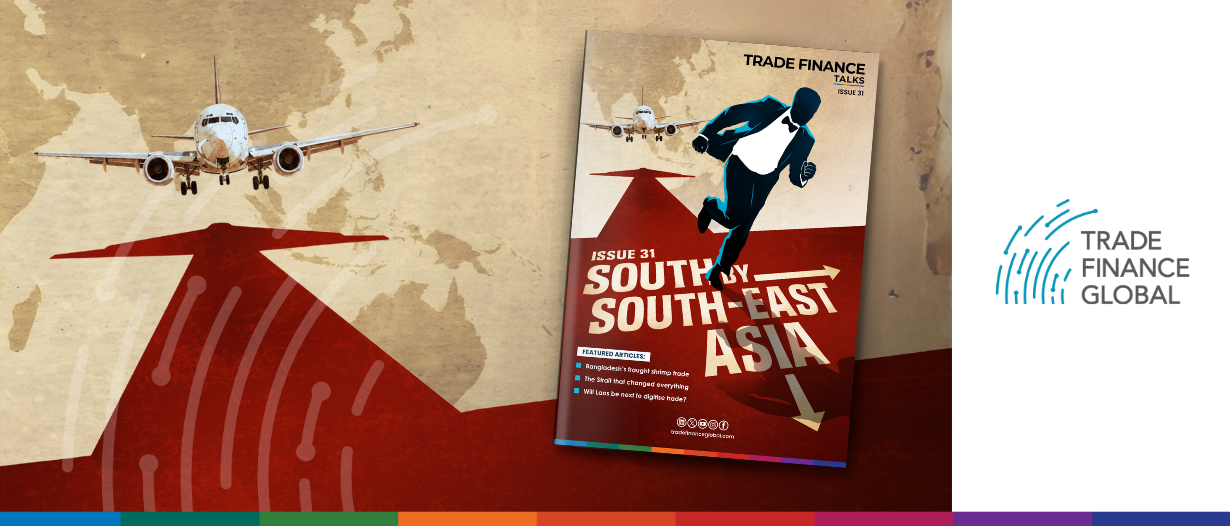

- Issue 31 of the Trade Finance Talks magazine is the South and South-East Asia edition.
- These economies have seen some of the worst disruption this year, whether the result of US tariffs or Middle East upheaval.
- This magazine reveals not only resilience, but active innovation there.
Alfred Hitchcock’s 1959 North by Northwest is a film about mistaken identity, spy networks, and hanging off Mount Rushmore. But at its core, it’s about a man hurtling towards destinations he hadn’t chosen, staying upright as geopolitical forces threw him off balance. The metaphors of thrill, but also of opportunity in uncertainty, lent themselves aptly to the first regional supplement of 2026: the South and South-East Asian edition.
These regions have been on our radar since last year. We knew to expect general elections in Bangladesh, Nepal, and Thailand – and if the experience of their neighbours was anything to go by, these changes of power are dramatic. Protests, military juntas, exiles, corruption: regional politics are strongly postcolonial, a mix of European-style democratic systems and monarchies.
South and South-East Asia were also directly and severely affected by Trump 2.0: the second term of US President Donald Trump and his now-ubiquitous barrage of tariffs. On the one hand, that China was subject to the most severe tariffs left a largest-economy-in-the-world-sized hole in global trade networks, with India a regional favourite to fill it.
Yet ‘Liberation Day’, on 2 April 2025, targeted South-East Asian nations with particularly punitive rates. Cambodia, Laos, Vietnam, and Myanmar faced duties of between 44-49%, while Thailand and Indonesia faced 36% and 34%, respectively. The US Trade Representative subsequently launched Section 301 investigations against Cambodia, Indonesia, Malaysia, Singapore, Thailand, and Vietnam, examining alleged structural excess capacity in critical sectors including auto manufacturing, electronics, metals, and rubber.
As such, countries in the region are both courted as alternatives to Chinese production, yet simultaneously scrutinised and penalised.
Which raises the question: why not write about China, Japan, or South Korea? What interests us more are the countries beginning to find their footing, the ones where opportunity is less mapped and risk less priced.
From the rhetoric we hear at industry events, South and South-East Asian economies are likely to benefit from the ongoing reconfiguration of global supply chains as part of these diversification strategies, even as the tariff environment complicates that promise and blurs the far sight. We wanted to write about Bangladesh and Nepal, Bhutan and Laos, Cambodia and Pakistan – countries thrust into a global supply chain story they didn’t architect, much like Cary Grant as Hitchcock’s Roger Thornhill.
One development we couldn’t have anticipated is how the region has also borne a disproportionate share of the disruption emanating from the Middle East. Shipping routes through the Strait of Hormuz and the Red Sea have been upended, and study after study has shown that South and South-East Asian countries are facing the severe consequences, whether that’s the result of port overcrowding or exposure to Gulf energy.
According to The Economist, Pakistan and Nepal are some of the worst-affected countries. On top of the aforementioned, they rely on remittances from their expat community, where workers migrate to the Gulf and send earnings home.
This crisis cemented, for us, the need for a South and South-East Asian magazine: a collection of (mostly) developing economies, yet crucial ones to cross-border trade.
The magazine is divided into two regions and four chapters. We first examine the internal affairs of South Asian economies, whether that’s in light of recent elections, or general attitudes towards banking there, and how they differ from Western approaches. Interestingly, speaking with local banks has brought fascinating points of similarity.
We then look at South Asia on the global stage, with record-breaking numbers of free trade agreements (FTAs) across steel, ships, and shrimp. In a region so severely impacted by natural disasters, it was eye-opening to hear about Pakistan’s rebuilding after severe floods in November 2025; natural disasters which are largely the result of a global energy crisis, not a regional one.
On this note, turning to South-East Asia, we examine sustainability measures. Regarding the balance of environmental and social development in countries which rely on adverse environmental practices to prop up their societies, the middle ground is shaky at least. One of my favourite pieces in this section is an exploration of forced labour commitments by Sam Baron, Policy Analyst and Researcher at SIPA Partners: the deafening taboo of the global supply chains we all frequently consume.
Finally, we cover digitalisation in South-East Asia, which, as a region, is highly progressive on this front. Where street vendors accept QR code payment, artificial intelligence (AI) agents execute trade transactions, and electronic sanitary checks bolster agriculture. It’s a narrative we’ve heard for some time now: without ties to legacy systems, developing economies have the flexibility to embrace the future.
We explore these themes and many more at our inaugural TFG Singapore conference on Wednesday, 20 May – which promises to be a confluence of trade and commodities practitioners from South and South-East Asia.
There aren’t many relevant quotes from North by Northwest for this magazine. Something about the world feeling more Hitchcockian, but with room for the underdog to shine?
Regardless, happy reading!