
















Listen to this podcast on Spotify, Apple Podcasts, Podbean, Podtail, ListenNotes, TuneIn
-
Ukrainian banks like PrivatBank are maintaining financial stability during prolonged blackouts by using generators, satellite connections and contingency planning to keep essential banking services running.
-
Despite ongoing war and infrastructure attacks, Ukraine’s financial system remains resilient, supported by the National Bank of Ukraine, international institutions, and strong public trust.
-
Banks are playing a critical role in Ukraine’s recovery by supporting businesses, distributing international funding, aiding reconstruction efforts, and caring for employees and veterans.
When Russian tanks rolled into the Donbas, Sumy, Kherson and other regions of Ukraine in the early morning of 22 February 2022, the world watched in horror as the familiar story – a small state bullied into submission by a global superpower – repeated once again. Since then, the role of financial institutions both as providers of financing and pillars of the community has grown more firmly entrenched in Ukraine.
Over three years on, and the world’s attention has flickered away – but the war goes on.
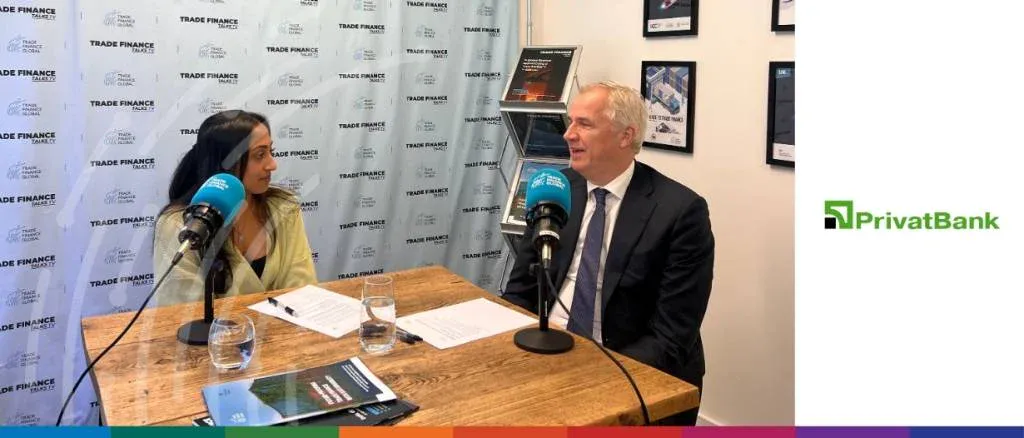
Mahika Ravi Shankar, Deputy Editor at Trade Finance Global (TFG), interviewed Mikael Björknert, CEO of PrivatBank, to learn more about how Ukraine’s biggest bank is maintaining normalcy for Ukrainians and their financial system during all-but-normal times.
Routines in wartime
Walking down the street in Kyiv or Lviv during the daytime, you may be forgiven for thinking that things have barely changed.
“I’m amazed by the drive of the Ukrainian people, how we just feel that this is something we just have to live with and continue to make the ordinary life as ordinary as possible,” said Björknert.
Despite nights spent in underground shelters and rattled by shelling and air raid sirens, during the day, people lead normal lives – children go to school, people go to work or to cafes and shops. This means that the financial system must keep up.
The Ukrainian Central Bank’s Power Banking project commits half the banks to be open at all times, even during power outages, which can last several hours at a time, as Russia is increasingly targeting Ukrainian energy plants. Beyond everyday requirements such as heating, especially as Ukraine’s cold winter draws nearer, frequent power cuts risk grinding the nation’s banking system to a halt.
PrivatBank uses generators, power banks, and satellite connections to keep 50% of its banks open at all times except during active shelling. The same goes for ATMs, POS terminals in shops and supermarkets, and other parts of the banking system, all of which need to remain resilient and trustworthy for the economy to remain strong.
“We need to prepare for different scenarios, including pessimistic ones. Such as a 10-hour blackout: everything needs to work even if we have 10 hours without electricity,” said Björknert. This extends beyond the bank’s own systems. Countries must ensure that businesses themselves have backup generators or batteries to power card terminals, and that they can always receive payments.
Currencies and businesses at risk
Geopolitical instability, especially drawn-out conflicts, can often spell trouble for currencies, rendering them vulnerable to hyperinflation or loss of trust. Does this mean Ukraine’s hryvnia is at risk of disappearing?
“As long as Ukraine is a country, there will be a currency. It can be strong, it can be weak, but the National Bank of Ukraine (NBU), International Monetary Fund (IMF) and the rest of the international society ensure that we keep our finances in good order,” explained Björknert.
What the war does create risks for, however, is the safety of data and clients’ access to funds. To prevent data centres falling into the wrong hands in the event of a more aggressive invasion, PrivatBank moved all its data to the cloud.
The shelling and invasions are also posing challenges for Ukrainian businesses, which are caught in between. But, Björknert reported, the morning after a shelling is filled with an influx of questions as to how to start again, “because everyone would like to restart. No one would like to give up.”
Rebuilding the country
As Ukraine’s businesses are impatient to restart, so are its people. Charity contributions, which are facilitated and often matched by banks, go towards rebuilding hospitals, shelters, and schools that have been hit by Russian attacks. For example, in September, PrivatBank provided 2.5 million hryvnias to help the Kyiv Institute of Cardiology after a Russian drone strike on the hospital.
However, the vast majority of funds to rebuild the country’s infrastructure will come through foreign direct investment or with the help of international financial institutions, for example, in the form of risk-sharing facilities. These allow banks “to reduce their risk so that they can continue to lend out to corporates, and corporates can continue to invest into society. And that’s really, really important,” explained Björknert.
Most of the estimated $524 billion needed to rebuild Ukraine after the war – nearly three times its GDP – will come from international institutions, but Ukrainian banks can help by distributing the funds and working with foreign investors on risk-sharing facilities. Many of these funds are disbursed by the IMF, which has a series of programmes to contribute to Ukraine’s reconstruction, one of which is about to be renewed.
A new source of funding?
While these grants normally work by disbursing funds contributed to the IMF by individual countries, there has been increasing attention drawn to the billions of dollars in frozen Russian assets held by European financial institutions.
Russia’s $200 billion sovereign reserves, frozen by the EU at the start of the war, are now increasingly being discussed as collateral for an EU-backed loan to finance Ukrainian reconstruction. However, international pushback and legal challenges are, for the moment, preventing the enactment of the plan.
Despite the challenges, Ukrainian sentiment remains positive, and there is widespread faith in the EU’s willingness to help.
“[Despite debate], I don’t think there’s a lack of will,” said Björknert. “We don’t, from a Ukrainian perspective, feel abandoned, not at all, even if this takes a little bit of time.”
Supporting veterans
Of PrivatBank’s 17,000 employees, over a thousand are in military service, making veteran and active combatant support an urgent priority. That often starts with remembering those who have passed away and those currently on the front lines, said Björknert.
“Respect is of the utmost importance. First of all, at nine o’clock for one minute every morning, the work stops, and we have a minute of silence – because out of those who have been in military services, 28 have died in combat.”
Working to support those who are drafted is equally important. PrivatBank continues paying a salary to employees even when they are doing their military service, and tries to maintain contact with the families throughout the time the employee is away.
When they return, “they should know that they still have their job. Eventually, someone else might take over their position […], but we ensure that they still are employees of Privatbank,” explained Björknert.
When employees come back, they often bring unique experiences from the battlefield – which can be harnessed in their work, but can also haunt them. “We try to let everyone get the time they need,” said Björknert. Support can be physical, psychological, and a community effort – veterans are best placed to support veterans.
—
Many hope that in just a few years the war will be a distant memory – but Björknert also dreams of a different way Ukraine looks at institutions like banks. He hopes for a move from a Soviet-esque distrust of financial institutions, towards one where they are inherently trusted, as we see in much of Europe.
The other dream, of course, is membership in the European Union (EU), perhaps within the next decade, which would give Ukraine many of the legal and economic institutions that have been helping Western Europe thrive.
“We have a lot to watch, we have a lot to learn. But I also think that Europe has quite a lot to learn from Ukraine,” said Björknert.