









-
The ongoing conflict has severely disrupted maritime and air supply chains, threatening approximately $158 billion of Indian trade with Middle Eastern partners like the UAE and Saudi Arabia.
-
India’s energy security is at risk due to the closure of the Strait of Hormuz, which serves as the transit point for nearly half of the nation’s oil and natural gas imports.
-
The hostilities have stalled long-term strategic projects, such as the India-Middle East-Europe economic corridor, and jeopardised the goal of doubling bilateral trade with the UAE by 2032.
The recent conflict in the Middle East has ground supply chains to a halt and disrupted maritime trade from the Mediterranean Sea to the Indian Ocean.
The disruptions in production may significantly set back India’s impressive trade growth, which last year greatly relied on trade with the United Arab Emirates (UAE) and Saudi Arabia. Both countries, along with Jordan and Lebanon, have been subject to significant bombing by Iran.
The near-total stop in cargo shipping in the Arabian sea, meanwhile, is already causing major losses for vessels carrying perishable goods that have had to be diverted due to the conflict. Recent damage to airports in the region and the closure of Qatari airspace may also foreclose air cargo as a backup avenue for some shipments, effectively choking off India’s opportunities for exports to the region for now.
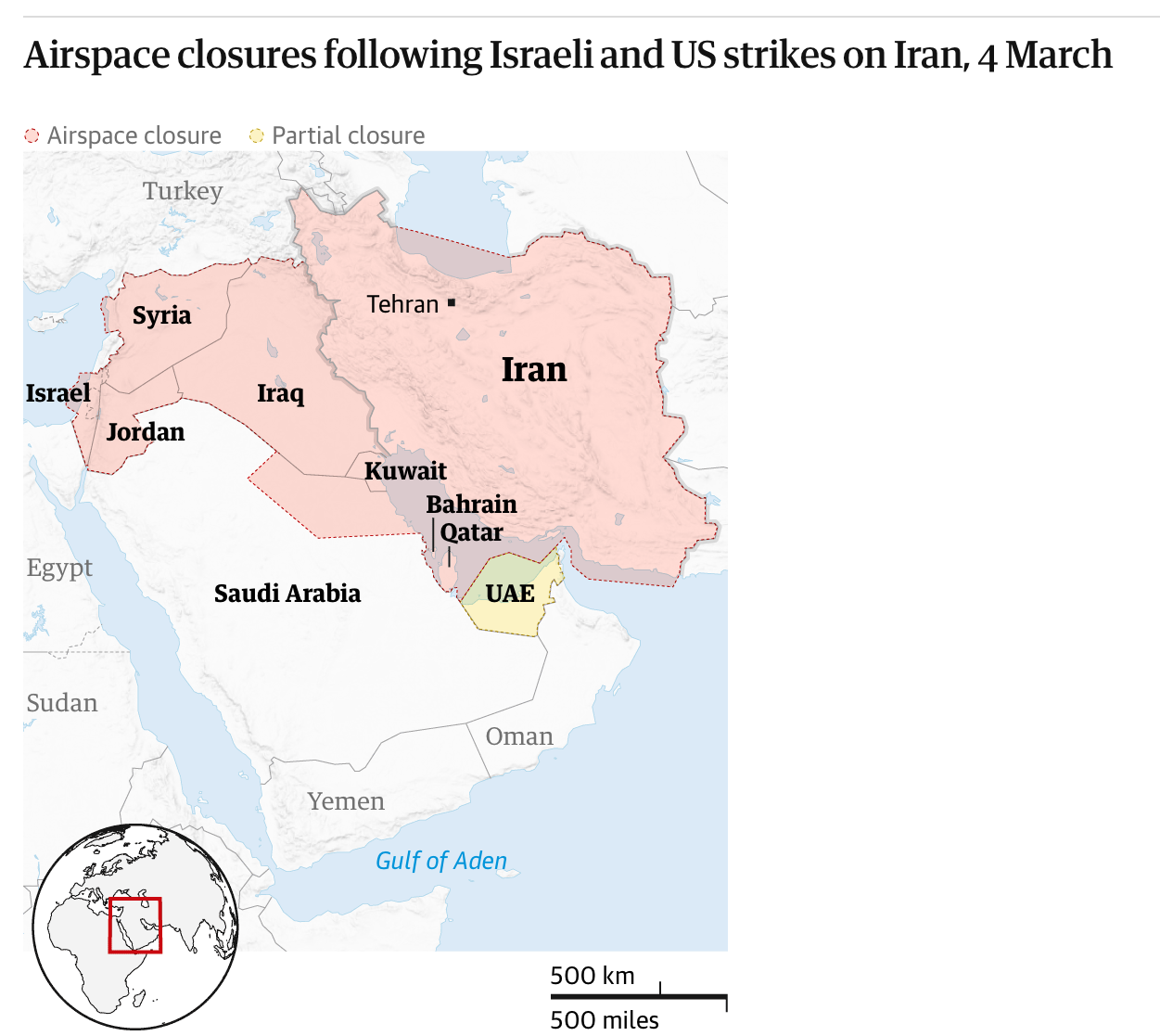
Source: The Guardian.

Iranian attacks on ships in and around the Strait of Hormuz. Source: The New York Times.
While the effect on oil and energy prices and the breakdown in international relations is likely to reverberate in economies all over the world, the impact on India may be worse still. The country, whose role in international trade had been on an astonishing upward trajectory before the war started, will suffer from both the halt in maritime shipping and the potential damage of some of its most promising trade relationships.
Trade between giants
Trade between India and the Middle East started in the Neolithic period, when pottery, plants, and livestock were traded from the Subcontinent to the Arabian peninsula. 4,000 years ago, the Indian Ocean was a crucial trade route for the spice trade, with Oman, Bahrain, and eastern Iran serving as key transshipment hubs.
A few millennia on, oil and gems have replaced spices and ivory, but the trading routes look much the same. 95% of India’s exports travel via sea: in December 2025 alone, the Nhava Sheva port, on India’s northwestern coast, saw over $6 billion worth of exports leave India’s shores, much of it bound for Malaysia and the UAE.
Most shipments bound for the Middle East travel via the Gulf of Oman and through the Strait of Hormuz, while exports to Europe transit through the Red Sea. The India-Europe shipping lane has recently experienced an “unprecedented volatility,” Trade Finance Global (TFG) reported in January, but the maritime link with the Middle East had remained relatively stable – until now.
In recent years, the Middle East has gone from watching ships with Indian exports pass by their shores, to being one of its key export markets. Last year, the UAE was India’s second-largest export destination after the US, generating over $38 billion in revenue – a 14% jump from 2024 and a key driver of export growth. The UAE is a key destination for India’s growing engineering and telecommunications sectors, which India has framed as strategic priorities. Indian nationals also make up over 30% of the UAE’s population, and the remittances they send back home are a significant source of foreign income for India.
On 24 February – just four days before the US bombed Tehran – India and the Gulf Cooperation Council launched negotiations for a free trade agreement that would lower bilateral tariffs and increase investment. In January 2026, the UAE and India set a target to double bilateral trade by 2032, bringing it to $200 billion a year and diversifying beyond oil and precious metals.
Seas in gridlock
The conflict puts nearly all of this in jeopardy.
Iran’s closure of the Strait of Hormuz and threats to “set ablaze” any ship that passes through it have cut India off from much of its oil and natural gas imports, nearly half of which pass through the Strait.
Most carriers – including Maersk, one of the world’s largest logistics companies – have completely halted shipments between the Indian subcontinent and the Middle East. This is creating a large backlog at Indian ports as goods meant for export arrive through inland trade and cannot go further, the Journal of Commerce reported.
The situation is even more dire for shipments that were in transit when the conflict started. About 90 container ships are stuck in the Gulf, reported the Financial Times, as drone attacks on nearby ports made it impossible for ships to reach their destination.
Fuel costs, diversion fees, and emergency surcharges are all being offloaded onto exporters, adding to the financial burden of delays. The delays also mean that shipments of fresh food or livestock – including, for example, frozen beef exports from Indian to the Middle East, an over $500 million a year industry – are being left to perish in their containers.
Logistics providers are exploring solutions like air cargo, overland transport, or transshipment via the Indian subcontinent or Africa, DHL CEO Tobias Meyer said on Thursday. However, it is unlikely any firm decision will be made in the next few days, leaving regional trade – and Indian exporters – in a growing limbo.
A dimming future
Besides short-term shocks in imports, the conflict could deal a blow to India’s foreign trade for years to come.
The India-Middle East-Europe economic corridor, proposed at the 2023 G20 conference and in the works ever since, aimed to strengthen the transport links between the three major trading partners. The corridor would improve maritime links between India and the Arabian peninsula by expanding the capacity of maritime routes to Saudi Arabia and the UAE through the Strait of Hormuz and link the Indian Ocean to the Mediterranean via inland transport.
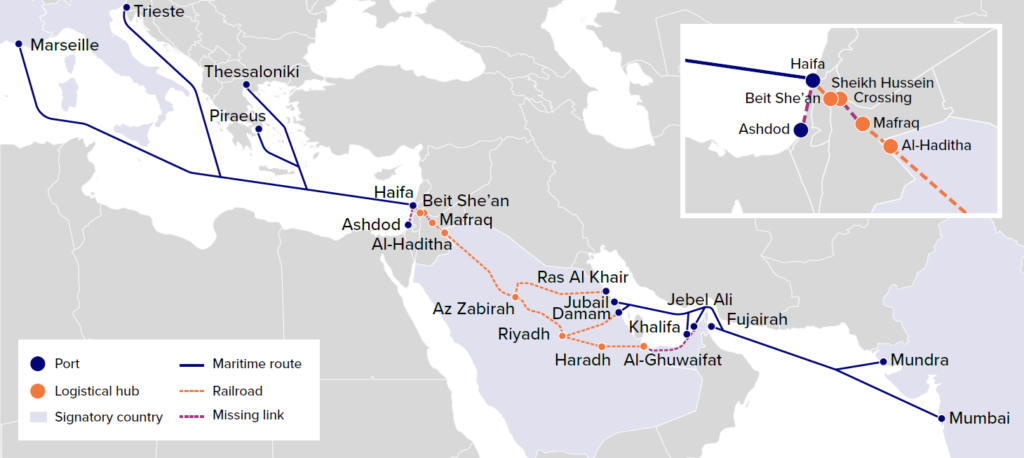
The proposed new routes of the India-Middle East-Europe economic corridor.
Source: Atlantic Council
The conflict has put these plans on hold, and even if the conflict has a swift resolution they are unlikely to resume anytime soon. Saudi and Emirati infrastructure has taken a hit due to the bombings, and rebuilding – as well as strengthening defense systems – is likely to become the top priority for the Gulf states after the war ends. India’s relatively neutral stance in the conflict has kept it free of controversy so far, but were the country to get dragged in further – which seems increasingly likely as fighting spreads into the Indian Ocean – trade relations with its Middle Eastern allies could suffer.
Trade between India and the Middle East was also slated to increase due to recent US influence. In August 2025, the US threatened India with 50% tariffs if it continued buying Russian oil, which is sanctioned by the US and Europe. In response, India forged stronger ties with the Middle East, from which it already gets about 55% of all its oil imports. These ties, however, might be weakening: on Thursday evening, the US granted India a month-long waiver, allowing India to purchase Russian oil.
This is a “deliberately short-term,” “stopgap” measure, said US Treasury Secretary Scott Bessent, intended to ensure India – which heavily relies on imported energy – maintains access to energy supplies. Oil and natural gas prices soared as the conflict increased, prompting some Indian energy companies to ration supplies to their customers this week.
——
The Iran conflict has already claimed thousands of lives, and its ramifications will no doubt affect supply chains for months to come. Behind its immediate impact on maritime shipping and its snowballing effect on oil prices, though, lies a far more sinister risk.
The war, launched by the US and Israel – two of the world’s most advanced economies – risks jeopardising the fast but fragile growth of India, which has for years been fighting for its place on the international trade stage.
By threatening maritime trade routes, disrupting Middle Eastern economies, and changing the geopolitical landscape, the conflict will irrevocably change India and the Middle East’s trade relationship. This could set India’s export growth, driven in large part by the expanding UAE market and enabled by oil imports and trade links, back significantly, tamping down its accelerating economy.