



















-
Corporate demand for greater financial transparency and efficiency has led banks to adopt a ‘product co-creation approach’ with their clients.
-
Third-party providers are currently outperforming traditional banks in market integration by offering flexible digital solutions that respond rapidly to market shifts.
-
The transition to instantaneous payments creates significant financial risk because foreign exchange markets do not operate $24/7$ and remain closed during weekends and holidays.
Foreign exchange (FX) poses a unique problem for the trade finance industry. The global scale of commodity finance leaves vendors negotiating a huge variety of international jurisdictions, regulations, and currencies daily.
While the speed of payments has skyrocketed, commodities themselves are still moving with ships. Financing multi-currency transactions that rely on assumed conversion rates is increasingly difficult amid the volatility of this decade.
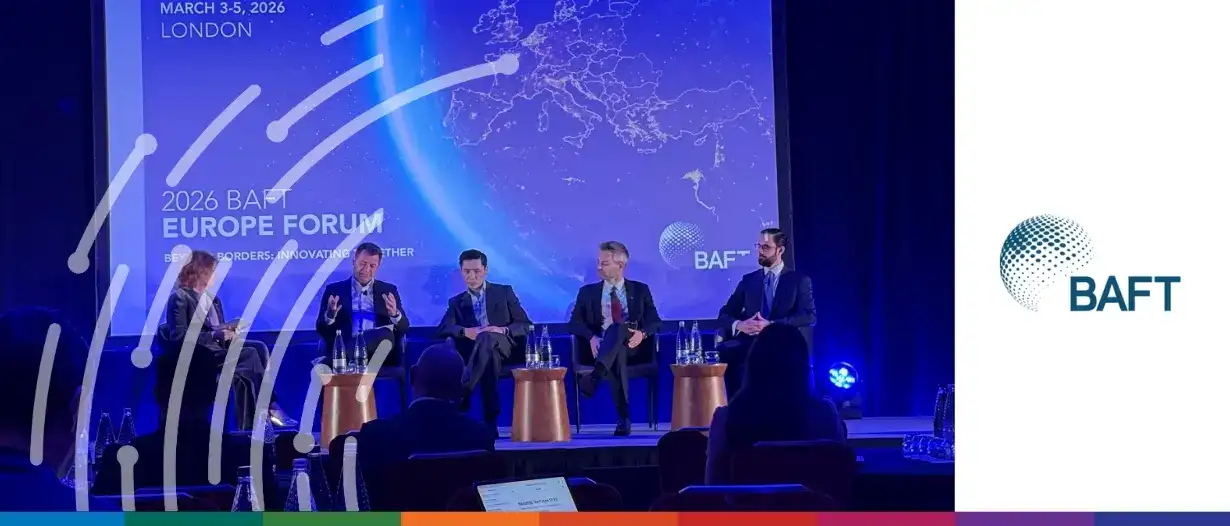
At BAFT Europe 2026, a panel moderated by Vanessa Manning, Head of Transaction Banking EMEA at MUFG, titled ‘Navigating the Future of FX: Innovation, Risk and Client Experience Transformation’ discussed the innovation led by corporates, the challenges of market integration and instant payments, and the future of FX.
Corporate competition drives innovation
The trend towards digitalisation, towards faster, integrated solutions and payment systems, has gripped the finance world. Corporate banks have led the charge, offering electronic documentation, advocating that governments legalise digital trade documents, and building and rolling out artificial intelligence (AI) and large learning models (LLMs) for fraud tracking and client services.
FX has not escaped the push toward instantaneous payments and integrated digital systems. However, uniquely, it is the banks that are playing catch-up.
There is a domino effect of the growth of new entrants to the FX market, particularly third-party providers offering digital solutions, on big banks. “Driven by the ambition to provide a high standard of service, banks are redefining pricing, FX, and user experience in corporate banking, delivering solutions that align with how clients expect to work today,” said Richard van Rees, Executive Director of Digital Money Products at UBS.
At the heart of this has been an increased push by corporates for financial transparency across transaction efficiency, rate transparency, and the quality of the rate, explained Marc Tuehl, Global Head of FX Overlay at HSBC.
Answering to these increasing needs in user experience, banks have shifted to a ‘product co-creation approach’ with clients, with dedicated UX research, client surveys, and continuous product feedback cycles.
Without these conversations, clients may often struggle to understand the implications of a certain solution, highlighted Luke Spires, EMEA FI Relationship Management Specialist at StoneX.
Beyond that, the panellists were in consensus that flexible and modular product offerings suitable for client adoption were at the heart of successful FX innovations.
With clients juggling everything from USDC and stablecoin balances to virtual assets on a wide variety of scales, alongside a growing number of interfaces and infrastructures needed to navigate these worlds, banking has truly become an ecosystem.
To navigate that and to ease friction, infrastructure integration is essential. The development of solutions “needs to be a two-way conversation,” said Dominic Ho, Global Head of FX Trading at Visa.
Notably, van Rees explained that one might expect clients to tend to use alternative solutions when being confronted with transparent, but higher fees in the client interfaces. However, “the opposite has been true,” he noted, adding that transparency actually creates an “invaluable” trust with clients.
Meshing with the market
For the world of FX, navigating client platforms is not the only challenge. FX solutions have to mesh with the market.
“The market always knows best,” said Spires. He added that the goal is to improve the market by “establishing how it’s integrated, how clients communicate with us, and how we communicate with them.”
Third-party providers like StoneX have quickly become leaders in FX provision for global banks and fintechs that otherwise lack the reach or infrastructure. Spires explained that their competitive edge was in the flexibility and market integration that allow StoneX to respond quickly to market shifts.
For bigger banks such as HSBC, market integration has offered opportunities for automation and efficiency. Data connectivity has enabled clients to integrate with transaction systems, automate strategies based on analytics, and connect operational workloads with execution models.
Tuehl explained that this level of integration allows for greater client autonomy and reduced administrative load by enabling clients to automate liquidity swaps.
The problem with instant payments
In the drive to T0 (the same day settlement of a financial transaction), many countries have mandated that banks be able to receive 24/7 instant payments via institutions such as the Federal Deposit Insurance Corporation (FDIC).
However, this poses a particular challenge for FX markets, as they are not permanently open. The market closes on weekends, and the timing is further complicated by national holidays and different time zones. The closures can mean that payments processed by banks while the market is shut, at an estimated or assumed rate, could go negative when the market is reopened.
The panellists were in agreement that instantaneous settlement increased risk for banks, requiring more continuous control frameworks to mitigate both fraud and FX risks.
Tuehl pointed out that this is a particularly significant issue for emerging and frontier markets, where “trade is not 24 hours, but linked to a very specific time window during which global markets are open.”
Widening the time gap between payments and market opening could increase transaction risks for countries, especially those where restricted markets already elevate costs.
The demand for the quickest possible solutions seems inevitable for large economies striving to meet the G20’s 1% transaction fee target by the end of 2027. But this means that emerging markets risk being left behind.
—
The growth in the number of FX players has raised market competition and driven bank innovation at scale. But, with such a focus on integration and interoperability across payment platforms, it begs the question of whether there are just too many solutions out there.
Whether the trend towards fragmented, personalised, and integrated solutions will continue, or whether we will see a return to centralised FX providers, remains to be seen.