














- Trade credit insurance capacity remains available, but insurers are applying stricter underwriting standards centred on transparency, deal structure, and detailed due diligence.
- Brokers are increasingly acting as interpreters of risk, helping firms navigate complex insurance requirements and bridge information gaps.
- ESG considerations are becoming a significant underwriting factor, particularly in sectors linked to the energy transition and critical minerals supply chains.
For years, trade credit insurance (TCI) has operated as one of the quiet yet indispensable pillars of global commerce, allowing traders to extend credit, pursue new markets, and navigate the risks that inevitably accompany cross-border trade, such as non-payment.
The TCI market is expected to expand even more significantly over the next decade, driven by rising global trade volumes and increasing demand for tools to mitigate losses. Much of this growth is being led by the Asia-Pacific (APAC) region, with China in particular deepening its position across global supply chains, which subsequently translates into wider credit exposure.
However, this rapid growth is unfolding alongside heightened uncertainty, meaning expansion is no longer simply about volume, but also about complexity.
Against a backdrop of geopolitical disruption, persistent volatility, and the fallout from a series of high-profile trading defaults, the safety net of trade credit insurance is facing renewed scrutiny, prompting questions across the industry about whether insurers are retreating from risk altogether or whether the nature of that risk is simply changing.
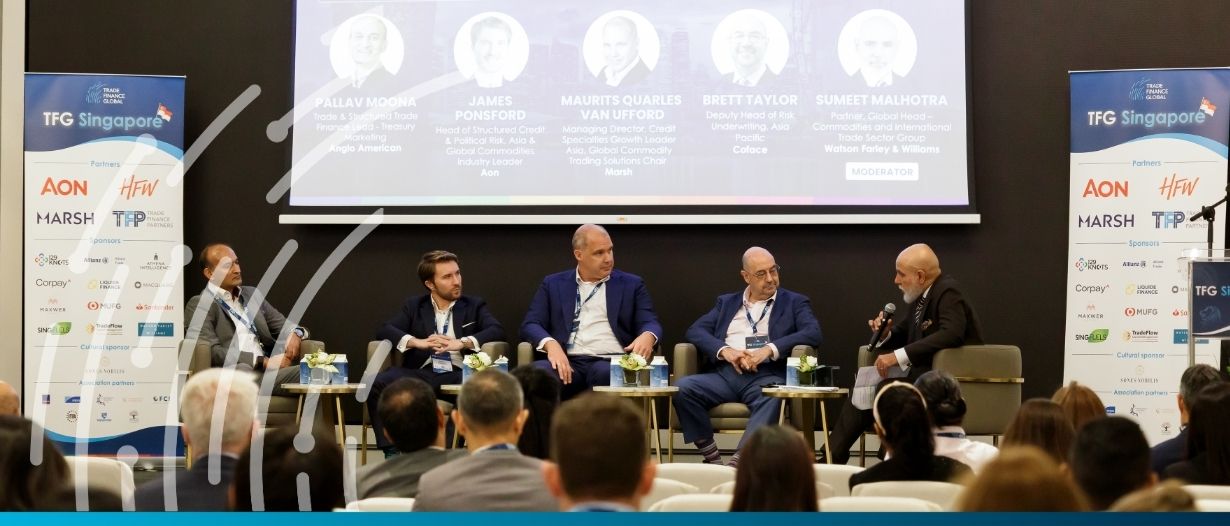
That said, a panel at Trade Finance Global’s (TFG) inaugural TFG Singapore 2026, moderated by Sumeet Malhotra of Watson Farley & Williams, brought together insurers across the industry, including:
- James Ponsford, Head of Structured Credit & Political Risk, Asia, at Aon;
- Maurits Quarles Van Ufford, Credit Specialties Growth Leader Asia, Global Commodity Trading Solutions Chair at Marsh;
- Brett Taylor, VP, Head of Risk Underwriting, South-East Asia, Banking & Financial Institutions at Coface;
- Pallav Moona, Lead Trade & Structured Trade Finance/ Supply Chain Financing at Anglo American.
What is happening in the world of TCI? Is it a withdrawal of capacity, or something far more nuanced?
From reputation to information
First and foremost, the key to the conversation is that commodity trade finance (CTF) has long relied on reputation as a proxy for risk, with familiarity and trust with well-known traders often forming the backbone of each transaction.
For much of the industry’s recent history, CTF ran on a simple premise: if a name was known, it was trusted.
The track record of established trading houses often informed risk assessments, with standing credit at times eclipsing hard data – meaning perception often travelled ahead of performance.
But since then, that approach has been dismantled gradually.
The turning point came in 2020, when a series of commodity trading collapses reverberated across Asia. The failures of prominent firms such as Hin Leong Trading and Agritrade International exposed the limitations of relying on reputation alone as an indicator of creditworthiness.
In response, underwriting standards tightened considerably. According to the panel, nowadays, privately owned entities experience heightened scrutiny, with due diligence conducted through a far more rigorous lens.
Increasingly, underwriters are expected to look beneath the surface of a transaction, rather than simply taking comfort in the name attached to it.
The emphasis in the sector has therefore shifted towards how a deal is structured, rather than who is behind it, with both recovery mechanisms and the chain of legal obligations now sitting at the centre of agreements. The field has left behind its more reputation-based approach for something far more informationally rich, underpinned by granular due diligence on individual transactions.
Ultimately, according to the industry experts, capacity is still very much there, and that is not where the pressure lies. Rather, what has changed is how the sector is accessed and supported.
Therefore, the uncertainty is no longer about whether capacity exists, but about how and for whom it is made available.
From intermediary to interpreter
For this reason, the role of brokers across the industry has evolved into something new and, in many ways, unexpected.
As transactions grow more fragmented, brokers are no longer acting solely as intermediaries but more as translators of risk, bridging commercial ambition with increasingly sophisticated insurance standards. What follows is a growing demand for solution-oriented structures, rather than the standalone presentation of risk.
The panel highlighted the newfound importance of brokers within today’s exchanges, particularly for smaller firms that often lack the same depth of internal data and reporting infrastructure as larger houses.
In an environment where contractual decisions are increasingly driven by the quality of information supplied, this creates a gap that can materially affect how risk is perceived and priced, depending on the size of the firm.
As a result, access to data is no longer uniform across the market, leading to diverging risk assessments depending on counterparty transparency. For less established companies, this makes long-term positioning more challenging under a more stringent TCI regime.
So, what is emerging – somewhat paradoxically – is that data-led underwriting may be increasingly reinforcing rather than closing the reputational disparity across the market, particularly for those without comparable data infrastructure.
Moreover, the panel cautioned that this more structured and metrics-heavy approach may also carry a ‘double-edged sword’, potentially creating future legal exposure by embedding detailed disclosures into the TCI record.
The takeaway, as the expert put it, is simple: stay close to your brokers in this market, unless you want to end up closer to expensive dispute resolution lawyers.
From ESG signals to credit risk
Another important point raised throughout the discussion was the growing influence of environmental, social, and governance (ESG) standards as an underwriting variable in their own right.
While often framed as a compliance exercise, the panel highlighted ESG’s increasingly direct impact on how agreements are structured and assessed, particularly in sectors linked to energy transition.
This is especially evident in markets supplying critical minerals such as lithium and copper, where heightened demand intersects with jurisdictions that often carry elevated political and operational risk.
Consequently, underwriting considerations are no longer confined to financial exposure alone, but increasingly extend to the geographic and regulatory contexts that might not have been considered beforehand.
In this sense, the shift away from non-renewable energy supply chains is not simply creating new opportunities, but is also reshaping the risk landscape itself. As new markets emerge, so do new and more complex forms of exposure.
—
Taken together, these developments point to a TCI market that is not necessarily contracting, but merely recalibrating. Capacity remains available, but access to it is increasingly determined by transparency, clarity, and the quality of documentation.
The result is a more selective, but also hopefully more resilient market, where trade continues to be supported, albeit on terms that demand greater structure and scrutiny than before.