



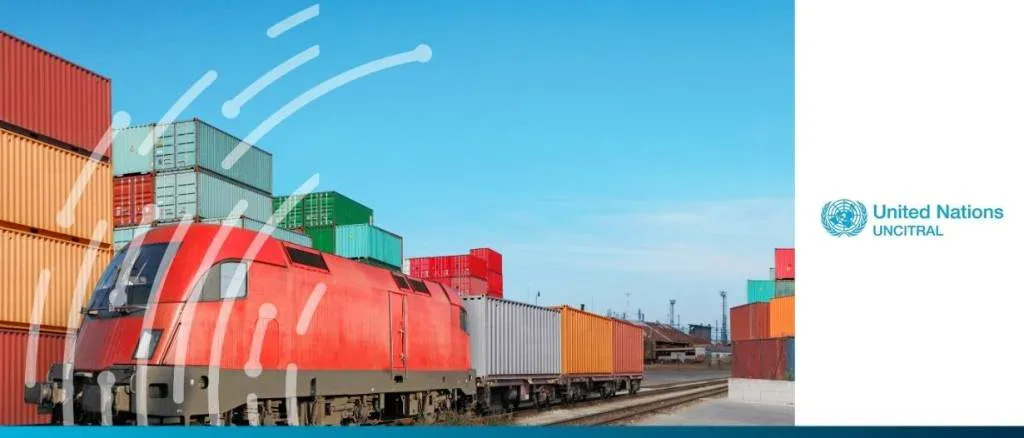

The United Nations Commission on International Trade Law (UNCITRAL) has given its backing to approving draft legislation that extends negotiable cargo documents (NCDs) to all forms of transport.
The draft convention, approved on Monday, 14 July, during UNCITRAL’s 58th session, addresses a legal gap that has hampered international commerce. Until now, only maritime transport has benefited from widely recognised negotiable documents – bills of lading – which allow goods to be bought, sold, or used as collateral while still in transit.
For cargo transported by road, rail, and air, the documents used have typically been non-negotiable, preventing them from being transferred to another party as a means of transferring the goods they represent. This disparity has created cash flow problems for businesses when goods are transported via inland routes, particularly for micro, small, and medium-sized enterprises (MSMEs), and in landlocked countries.
The new framework establishes harmonised legal provisions for negotiable documents of title across all modes of transport (that is, air, road, rail, and sea) regardless of how many different transportation methods are used for a single cargo shipment.
James Hookham, Director of the Global Shippers Forum, praised the convention as “a positive and progressive step forward, offering new opportunities to shippers, particularly in developing and emerging economies.”
He highlighted that the framework would provide greater legal certainty for freight forwarders’ multimodal bills of lading, which for over 50 years have relied on contractual agreements between parties rather than international law.
Andrea Tang, Legal Services Director at FIATA International Federation of Freight Forwarders Associations, built on this notion. She described the approval as “a pivotal moment” for international trade, for its establishment of a “harmonised legal framework for negotiable cargo documents, whether in paper or electronic form, facilitating both transport and trade finance across all modes of transport”.
The draft Convention supports the shift from paper-based to digital document exchange. It allows for the use of a single electronic record for multimodal and unimodal transport, enabling all stakeholders, from carriers and freight forwarders to customs and financial institutions, to work with the same data and reliability standards.
Universal and multifaceted benefits
Jun Xu, Vice Chair of the Steering Committee at the ICC Banking Commission, emphasised how the draft Convention will benefit stakeholders across the international trade spectrum.
Of course, for exporters, goods can be secured before receipt of payment – “as they usually do with the full set of original maritime bills of lading under letter of credit transactions”, explained Xu.
But the draft Convention, Xu went on, will also benefit traders, and those in shipping and insurance, by providing them more business opportunities; it will “increase trade financing capacity of SMEs importers by using NCDs as collaterals under non-maritime shipment or multimodal transport mode”; and it will provide banks with extra collateral to mitigate financing risks.
—
Fragmented legislative systems tend to hold back international trade, but “the NCD Convention provides long-awaited legal certainty for commercial actors, reinforcing the established role of freight forwarders and logistics providers as contractual carrier,” summarised Tang.
This digital approach aligns with broader trade facilitation objectives, including those outlined in the UN Digital Compact and the World Trade Organization’s (WTO) Trade Facilitation Agreement.
Beate Czerwenka, Chair of Working Group VI, said, “Thanks to the new draft convention on negotiable cargo documents, the vision of a world where trade is faster, safer and more accessible is becoming a reality.”
The draft Convention will now be transmitted to the United Nations General Assembly, with a recommendation for adoption during the General Assembly’s 80th session in late 2025. “All Member States are encouraged to support this transformative instrument in the General Assembly,” said Czerwenka.