














- International cross-border trade carries inherent risks beyond domestic transactions – including commercial risks, political risks ranging from tariffs and sanctions to civil unrest, and operational risks.
- Political and country risk is particularly complex in emerging markets.
- TCI addresses commercial credit risk directly, but businesses must look to complementary solutions to build truly comprehensive protection across their supply chains.
Author: Silvia Andreoletti, Senior Reporter, Trade Finance Global (TFG)
International trade is far less dangerous than headlines would have you believe, but it undeniably carries more risk than domestic trade for buyer and supplier alike.
The first step in managing the risk is being aware of it: each company and each transaction will have a different risk profile depending on a range of factors. This chapter will unpack the different forms of risk that can come up in cross-border trade, and the types of insurance that cover for them.
For example, risk will vary according to:
- The type of goods being traded: Fragile and perishable goods may carry more risk of deteriorating in transit, while commodities may be subject to sudden price fluctuations.
- How and where the goods are being transported: Long, multi-leg journeys tend to be riskier, and each country the goods pass through carries its own political risk.
- The parties involved: Even more than in domestic transactions, dealing with a new buyer can involve the risk of non-payment, fraud, or buyer default.
These factors determine which risks suppliers are vulnerable to and how much they should be worried about them. Each risk broadly corresponds to a type of insurance (see Chapter 5 for a detailed breakdown of different policies and what they protect against). However, to choose the correct coverage, businesses must first be aware of the potential risks and what they involve.
While trade credit insurance (TCI) is comprehensive, there are other aspects of supply chain risk and international trade that are not within the scope of the TCI policy. This section will also introduce complementary solutions for these risks.
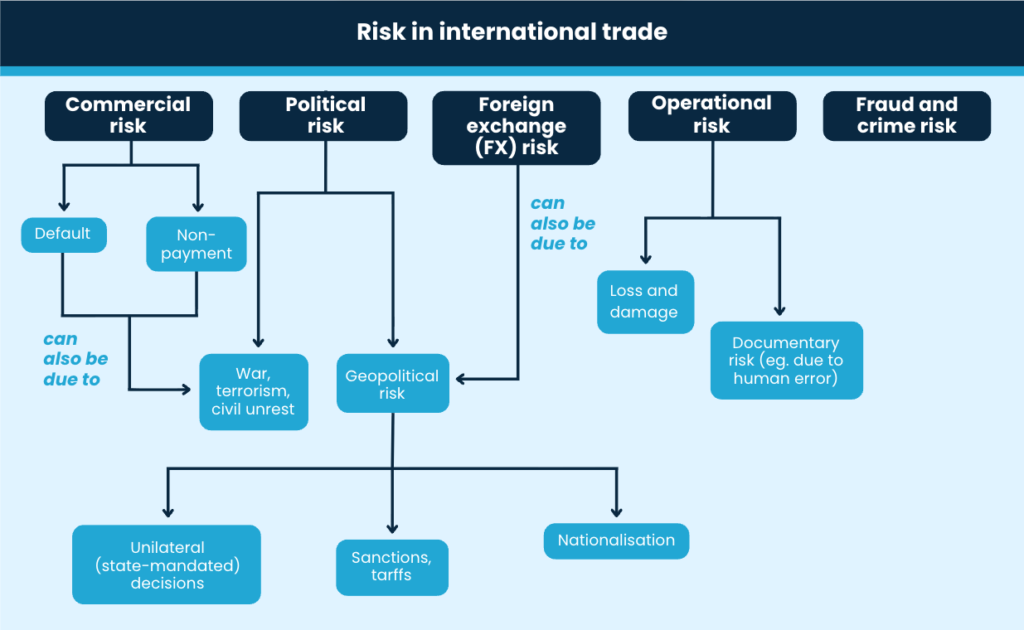
Commercial risks
Author: Sarah Murrow, President and CEO, Allianz Trade Americas
Commercial risk is the most basic type of risk in almost any transaction: the risk that the buyer will default and not pay the supplier. This risk is even higher in first-time cross-border transactions, as these often involve parties that have not interacted before, making it hard to build trust or estimate creditworthiness. Commercial risk usually refers to defaults related to normal economic activity, for example, liquidity issues or insolvency of the buyer, and not to force majeure events – extraordinary, unforeseeable events that contractually free parties from liability, like war or natural disaster.
Cross-border trade offers growth and diversification opportunities but also introduces a variety of risks that businesses must consider and manage. One of the primary challenges lies in navigating differences in legal systems, regulations, currencies, and contract enforcement, which can complicate transactions and dispute resolution.
Insolvency risk becomes particularly complex in international trade, as each jurisdiction has its own insolvency rules and recovery processes, making it harder to predict outcomes and recover debts.
Payment delays are another common issue in cross-border trade, often caused by foreign exchange (FX) controls, banking disruptions, or administrative hurdles in the buyer’s country.
Additionally, businesses must contend with broader country risks, including economic instability, currency volatility, sanctions, and sudden regulatory changes, all of which can impact the buyer’s ability to fulfil payment obligations.
To mitigate these risks, cross-border trade demands robust controls around contracts, documentation, fraud prevention, and clearly defined payment terms. By implementing these measures and leveraging trade credit insurance (TCI), businesses can protect themselves against potential losses and trade with greater confidence in the global marketplace.
The two primary risks covered by TCI are insolvency and protracted default.
Insolvency occurs when a buyer is legally declared unable to pay its debts. It includes formal insolvency events, such as a court-ordered bankruptcy, administration, receivership, or liquidation, as well as circumstances where a buyer is unable to meet obligations, such as an arrangement with creditors or a composition of debts.
Protracted default, or also referred to as slow-pay, refers to situations where payment from a customer remains outstanding beyond the agreed terms of payment and waiting period, despite the buyer remaining operational/solvent.
These risks can emerge due to financial mismanagement, liquidity constraints, sector downturns, or broader economic pressures. TCI protects suppliers against these events, ensuring continuity of cash flow and reducing exposure to unexpected customer non-payment.
TCI is designed to protect against non-payment arising from genuine credit risk, not from disputes between a supplier and buyer. Where a receivable is contested, for example, due to disagreements over product quality, delivery terms, or contractual performance, the amount is typically considered ‘disputed’ and falls outside the scope of cover until the dispute is resolved. Insurers require that the underlying obligation to pay is valid, enforceable, and undisputed before a claim can be admitted.
Similarly, TCI does not generally cover losses arising from fraud. This may include situations involving misrepresentation, fictitious buyers, or deliberate deception in the underlying transaction. While insurers apply rigorous underwriting and monitoring processes to help mitigate these risks, they are not intended to replace internal controls or due diligence by the supplier/ policyholder.
As a result, effective credit management remains essential. Suppliers/ policyholders are expected to maintain strong contractual practices, verify counterparties, and manage disputes proactively. TCI complements these efforts by protecting against genuine credit deterioration, but it does not extend to performance-related disputes or fraudulent activity. That would be covered by fraud and crime insurance.
Global credit insurance protects against commercial risk, including during cross-border trade. Some global credit insurance also covers other risks outlined below, which arise, for example, when the buyer is unable to pay due to external factors like political or economic turmoil.
Political and country risk
Author: Silvia Andreoletti, Senior Reporter, TFG
Political risk is the risk that a transaction will be affected because of political events. Political risk is one of the most common types of risk specific to international trade: it can look like civil unrest delaying shipments by truck, which in turn delays payment, or geopolitical tensions leading to rising tariffs and sanctions, as seen by US President Donald Trump’s ‘Liberation Day’ tariffs.
The most extreme types of political risk – terrorism, civil unrest, or the outbreak of conflict – are rare, but they can be incredibly disruptive to all areas of business, as seen with the turmoil in the Strait of Hormuz following the outbreak of the conflict in the Middle East on 28 February 2026 (more on this in Chapter 5). More commonly seen forms of political risk are geopolitical: for example, tariffs or politically motivated changes in port or border fees.
The last type of political risk is jurisdictional, which occurs when political changes in a country (such as a new law or the nationalisation of a major company) affect international trade. These often come with enough notice to give exporters time to adapt, but when they happen quickly, they can delay shipments and cause a loss of revenue.
Political and country risk assessment in emerging markets
Author: Gabrielle Reid, Chief Strategy and Growth Officer, PANGEA-RISK
Reducing risk in cross-border trade requires a structured understanding of how political and country risk materialises across jurisdictions. In emerging markets, risk rarely presents as a single event. It emerges through interconnected political, macroeconomic, and security dynamics that affect payment flows, currency convertibility, and contract enforceability amid wider political instability and macroeconomic volatility considerations.
In Nigeria, for example, the country’s ongoing FX reforms have improved transparency, but liquidity constraints persist. Delays in dollar access have affected importers’ ability to settle shorter-term trade obligations, highlighting how currency inconvertibility and policy transition risks can directly disrupt cross-border payment flows and insurer exposure.
In contrast, continued pressure on Pakistan’s balance of payments and reliance on external financing have sustained tight capital controls. Import restrictions and delayed letter of credit (LC) issuance illustrate how sovereign stress transmits into transfer and payment risks, constraining trade finance availability despite underlying commercial demand.
At the same time, developments further afield can have direct implications for markets closer to home. Recent security threats to Strait of Hormuz shipping routes have increased war risk premiums and disrupted key trade corridors. Rerouting and higher insurance costs demonstrate how geopolitical tensions can rapidly escalate operational risk, affecting delivery timelines, contract performance, and the pricing of marine and trade credit cover. Effective assessment, therefore, depends on a methodology that is both granular and forward-looking and takes into account several interconnected factors.
PANGEA-RISK applies a proprietary scoring framework across all recognised markets, enabling comparison of 10 distinct perils that shape the country risk environment over a one-year horizon. Each peril is scored on a zero to 10 scale, ranging from low to severe risk, and reflects specific dimensions such as political instability, insecurity, and credit dynamics.
The methodology is indicator-based and combines quantitative and qualitative inputs. Structured data from official and market sources provides a consistent baseline, while daily intelligence briefings synthesise historical and current developments into a coherent risk narrative. This is complemented by human intelligence, which offers on-the-ground context often absent from formal datasets, and a curated media monitoring system that captures real-time shifts in the risk environment.
A key feature of the framework is the use of weighted scoring to reflect the relative impact of different risks on business continuity. Political instability, insecurity, and transfer restrictions are prioritised due to their immediate implications for cross-border transactions.
Analysis across several emerging markets shows that deterioration in currency convertibility and transfer risk – the threat of not being able to convert a foreign currency back into a local one – frequently emerges before broader sovereign stress becomes visible through formal ratings actions, underscoring the importance of monitoring operational and liquidity indicators alongside macroeconomic data.
For insurers and trade finance providers, this methodology supports more precise risk selection, pricing, and structuring. By linking political developments to operational outcomes, it enables a clearer understanding of where vulnerabilities lie and how they may evolve, strengthening resilience in an increasingly complex global trading environment.
Intelligence advisory platforms support insurers by translating complex country dynamics into actionable underwriting insight. Country risk intelligence platforms increasingly support insurers and trade finance providers by translating political, macroeconomic, and security developments into transaction-level risk analysis. PANGEA-RISK’s framework, for example, assesses how developments such as FX shortages, election-related instability, or conflict escalation may affect repayment capacity, transfer risk, or contract performance within specific trade finance structures.
This type of analysis is particularly relevant during periods of heightened volatility. In countries experiencing temporary liquidity pressures, insurers may adjust transaction tenor, pricing, or exposure limits, rather than withdraw support altogether. Similarly, scenario-based monitoring during elections or periods of political transition can help identify sectors and counterparties most vulnerable to disruption.
By combining structured indicators with continuous monitoring and local market insight, country risk analysis provides insurers with a more forward-looking understanding of how risks evolve over time. This strengthens underwriting discipline and supports more resilient cross-border trade and investment decisions in a complex operating environment.
Operational risk
Author: Silvia Andreoletti, Senior Reporter, TFG
Operational risk is any risk that is due to human error or external events like bad weather or equipment failure. In international trade, this can look like lost or damaged goods (for example, because of a storm or improperly secured goods), incorrectly filled-out documents, or other disruptions not caused by political events.
The loss of goods in transit is often covered by freight, marine, or cargo insurance. The party responsible for organising freight insurance varies, and is determined by the international commerce terms (Incoterms), the standardised terminology associated with freight forwarding. Some countries, such as Morocco and Indonesia, have made freight insurance mandatory for imports, especially on goods transported by ship.
Human error – for example, an incorrectly filled out form leading to delays at the border – can also lead to costly delays. This is also referred to as documentary risk. Firms often take out specific insurance to cover different operational risks, such as cyber insurance, directors’ and officers’ liability insurance, or property damage and business interruption insurance.
Supply chain risks
Author: Madeleine Whiteley, Client Director, Aon
Supply chain disruptions impact nearly every corner of commerce and remain firmly on the minds of global business leaders.
But there is a risk solution that can help risk managers mitigate some of the impacts of supply
chain volatility, as they consider what risk to mitigate and their acceptable risk retention level:
trade disruption insurance (TDI).
This specialised, named-peril form of insurance addresses some of the vulnerabilities associated with cross-border supply chains by providing coverage for gaps in property and marine programs, such as natural catastrophes and non-physical damage losses to critical infrastructure, including blockades, strikes, and protests.
FX risk
Author: Silvia Andreoletti, Senior Reporter, TFG
FX arises in cross-border trade when a transaction involves two or even three different currencies (for example, the buyer’s currency, the supplier’s currency, and a third, ‘universal’ currency like the US dollar).
FX rates are constantly changing and can undergo major shocks due to geopolitical or economic events. When this happens, a buyer might be unable to complete a transaction because it has become much too expensive in their local currency – or vice versa, if the supplier’s currency has devalued, they may be seeing far less money than expected in a transaction.
In some cases, extreme currency crises can make international payments impossible. In August 1982, for example, Mexico was in the middle of a monetary crisis: its treasury secretary was about to announce the country could no longer service its $80 billion debt, inflation was rising, and foreign reserves were dwindling. The government responded by banning all foreign currency sales and converting accounts held in dollars into pesos. This meant that suppliers could only pay their suppliers abroad in the quickly devaluing peso, which many companies did not accept.
FX risk is often managed by hedging (using options or forward contracts to reduce the impact of major fluctuations), especially by larger companies and in collaboration with banks. Firms can offset some of the risk by trading only in their own currency, but this can preclude trading opportunities by foreign firms who are also unwilling to bear the risk of currency fluctuations or don’t have access to hedging tools.
In some cases, export insurance may cover non-payment by a supplier that is due to currency shocks; however, TCI does not normally cover losses caused by currency fluctuations. Transfer risk, which arises during extreme FX crises, is also often covered by political risk insurance (PRI).
Fraud and crime risk
Author: Silvia Andreoletti, Senior Reporter, TFG
The risk of fraud is present in every area of business; however, recent cases involving cross-border trade and the international commodities market have highlighted the vulnerability of the industry. Crime can be as simple as theft of the contents of containers in transit, or as complex as an intricately fraudulent document.
While in some cases, funds can be recovered by collaborating with local authorities, some insurers do offer coverage against loss due to crime. Fraud and crime insurance, or specific policies like commodities documentary fraud insurance, can help protect businesses.
Regulatory and sanctions risk
Author: Silvia Andreoletti, Senior Reporter, TFG
Regulatory risk arises when rules governing international trade between two countries change rapidly – for example, during tariff wars or quickly developing international crises. Some sanction regimes and tariffs become effective almost immediately, which can affect goods that are already in transit.
While tariffs can at worst lead to much higher transport prices (often paid by the exporter), developments in sanction regulations can make the supplier vulnerable to legal issues. Losses caused by tariffs or changes in other border fees are often covered by PRI, but insurers are increasingly offering specialised trade disruption insurance policies to cover supply chain disruptions and regulatory changes.
Case study: HSBC, UKEF, and Masters Speciality Pharmaceutical
Author: Craig Green, Export Finance Manager, UK Export Finance
Based in Elstree, Masters Speciality Pharmaceutical was founded in 1984 by Dr Zulfikar Masters OBE. Its work centres on providing access to specialist medicines in more than 75 countries across the Middle East, Asia, Africa and Latin America.
Last year, the company secured two large export contracts to Saudi Arabia, totalling over £2.3 million. The contracts were for the supply of a treatment for sickle cell disease and a specialised antibiotic against life-threatening infections.
To fulfil the orders, Masters needed insurance against non-payment and working capital to pay suppliers in advance – a frequent challenge for exporting small and medium-sized enterprises (SMEs). But the orders exceeded Masters’ credit facility with HSBC UK, which meant the business would have been unable to secure the contracts without additional finance.
UKEF stepped in with Export Insurance Policies against the risk of non-payment, giving HSBC UK the confidence to raise credit thresholds. This enabled Masters to meet working capital requirements without affecting day-to-day operations.