

















-
Trade finance is rapidly shifting from manual processes to digital platforms as firms seek greater operational resilience amid geopolitical uncertainty.
-
Automation and AI are accelerating transaction speeds in a traditionally complex and fragmented sector.
-
Collaboration between banks and technology providers is emerging as essential to overcoming integration challenges and enabling widespread digital adoption.
As geopolitical tensions and supply chain disruptions continue to reshape global commerce, corporations are increasingly reassessing their operational infrastructure. In doing so, many are being forced to rethink how they manage procedural risk and administrative complexity at scale.
Over the past few years, amid a climate of renewed instability, a sector historically dependent on manual processes and legacy systems is increasingly turning toward digital solutions, with automation no longer simply being a long-term ambition, but revealing itself to be a practical necessity.
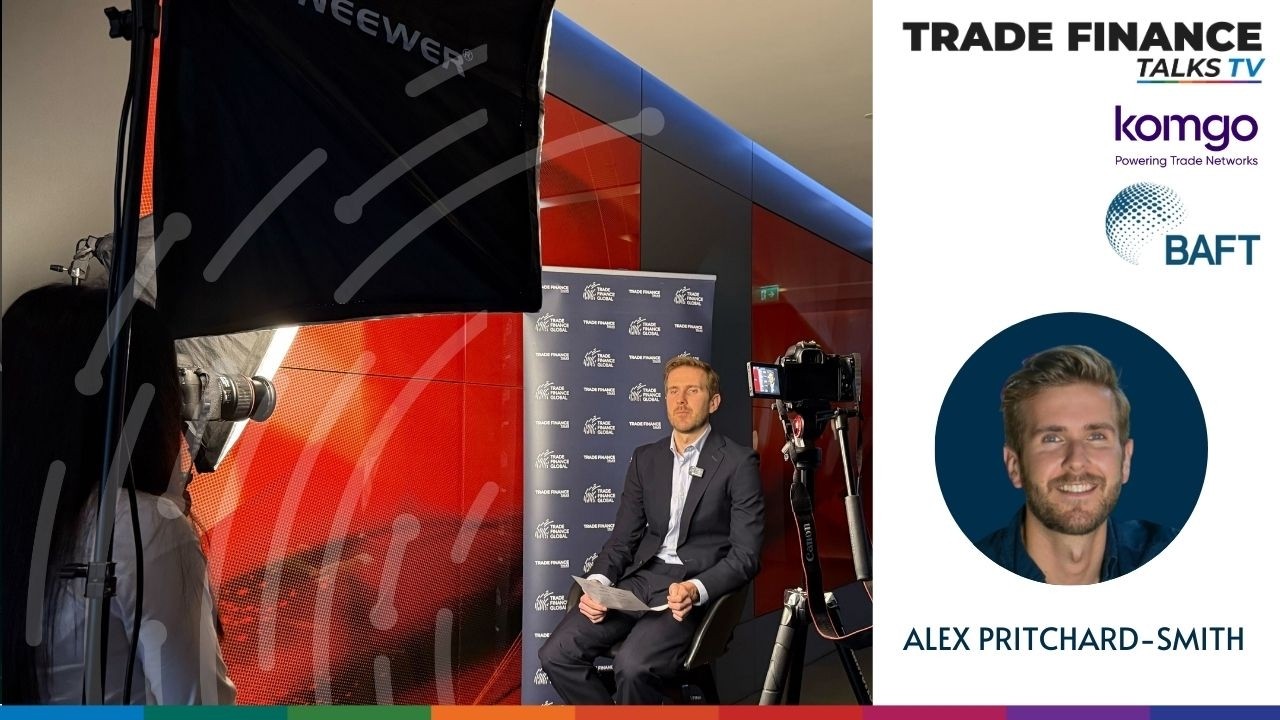
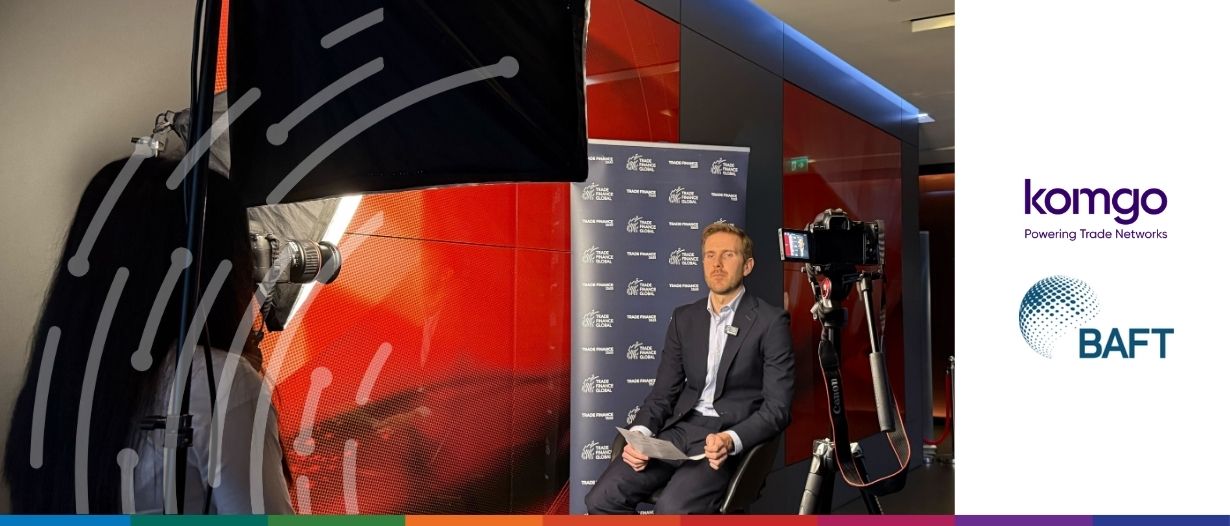
Speaking to Trade Finance Global (TFG) at the 2026 BAFT Europe Forum, Alex Pritchard-Smith, UK Country Head and Senior Sales Lead at Komgo, stressed that organisational robustness is becoming a priority for firms, as the industry moves beyond its traditional reliance on spreadsheets and emails.
“In the past 12 months, we’ve seen a lot of uncertainty on the geopolitical side,” Pritchard-Smith explained. “I think this has fed into a need for more operational resilience within corporates.”
Where trade meets complexity
This challenge becomes particularly acute in areas involving large guarantee and trade portfolios – sometimes worth “a billion dollars,” as Pritchard-Smith noted. These are often managed across multiple jurisdictions.
As transaction volumes grow and workflows stretch across wider geographic markets, the limitations of fragmented systems become progressively difficult to ignore.
Without a centralised and computerised platform, maintaining clear oversight can quickly become a resource-intensive task, placing a heavy organisational burden on treasury teams.
Industry commentary indicates that growing pressure to digitalise trade finance is already driving a wider shift toward more integrated and holistic forms of automation. Back in 2023, the International Chamber of Commerce (ICC) indicated that between 60% and 80% of global trade could be digitalised by the end of 2026. And, paired with the emergence of the Electronic Trade Documents Act (EDTA), that projection may no longer seem overly ambitious.
A similar emphasis on artificial intelligence is gaining traction in wider economic analysis as well. The World Economic Forum’s (WEF) Chief Economists Outlook for May 2025 shows broad consensus among respondents that both public investment in AI infrastructure and stronger private-sector adoption will be necessary to sustain long-term financial growth.
In practice, this push for modernisation is steadily reflected in the rising role of specialised technology providers. According to Pritchard-Smith, Komgo is one such provider, with a growing number of firms turning to the platform for support when managing their more stagnant operational undertakings.
The Geneva-based fintech enterprise develops software aimed at assisting banks and corporates through a single digital interface, eliminating the need for any paper documentation or other more disconnected communication channels.
Pritchard-Smith explained that the platform reflects a lingering frustration within the industry: “Cash payments and foreign exchange have benefited from digital solutions for a long time,” leading many actors to question: “why can’t we have the same in trade?”
A growing body of research points to improved efficiency as one of the key advantages associated with new digital trade finance systems. By structuring and standardising transactions across networks, documentation processing becomes more streamlined, reducing the need for manual data entries that may lead to errors or fraud – two long-standing challenges in the field.
As Pritchard-Smith added, these developments are especially valuable in a sector where timing is of the essence. “Trade is also very time sensitive, and a lot of our corporate clients are very focused on speed of service from their banks.”
Connecting a fragmented system
However, while tools such as Komgo promise efficiency gains, the adoption of these systems also risks creating a number of complications.
Trade finance remains a highly disjointed landscape involving major financial stakeholders and complex global logistics, meaning the success of digital transformation depends on multiple players acquiring the same network standards. Integrating new tools with existing banking architecture can also prove technically difficult and costly, particularly for institutions still reliant on legacy technology.
The result is a growing concern that several competing digital solutions may develop simultaneously, producing overlapping infrastructures rather than a single coherent framework for global trade.
Thankfully, in response to these structural hurdles, many actors within the ecosystem are turning toward partnership-based models rather than attempting to build one dominant standalone skeleton or risking falling behind in the spreadsheets. This suggests that the evolution of digital trade finance is increasingly being shaped by collaboration.
Pritchard-Smith noted that the dynamic can look different depending on the transaction, with banks often approaching it from different angles. “Some can look at it as a way to win new business, others will look at it more to defend wallet share,” he said. “But the idea is to provide a platform that’s going to benefit the bank as well as the corporate,” highlighting that both sides ultimately stand to gain.
—
The same collaborative logic can also be visible in partnerships between technology providers themselves.
Komgo, for instance, has worked with firms such as FIS Global, a provider of treasury management systems, illustrating how companies are linking
specialised services across trade finance more and more. This points to a more distributed model, rather than the single-platform approach many initially expected.
In an environment of continued geopolitical and economic disruption, such cooperation may, in time, make trade finance’s retrieval from more conventional systems not only possible, but also far easier to navigate.