













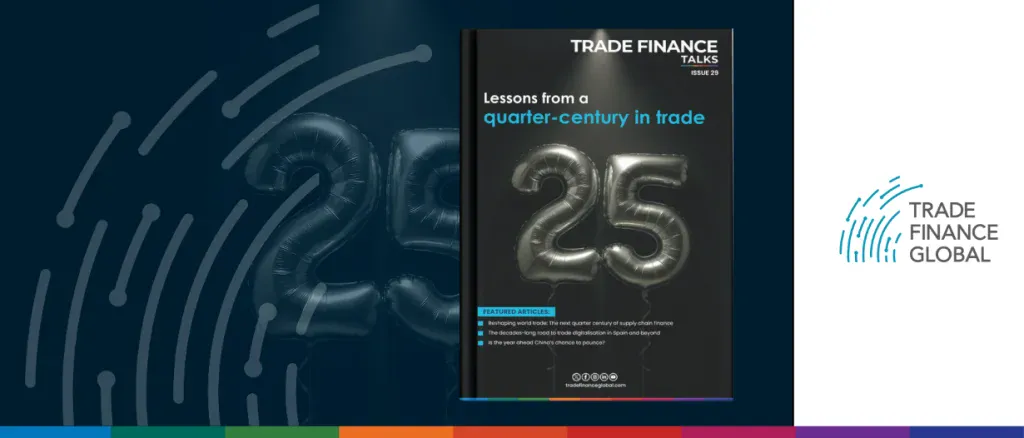


A year in the making, Trade Finance Global (TFG) is proud to bring our final magazine of 2025, as 21st-century trade finance enjoys its silver jubilee.
The twin towers still stood when this century’s trade finance mechanisms first hummed into gear. Crude oil commanded markets then as it does now, though the commodity’s dominance has weathered extraordinary stress tests: dozens of wars and insurgencies brought supply chains back to the drawing board; a pandemic proved even energy demand wasn’t immutable; and a financial crisis exposed how brittle securitisation had made trade credit, making the 2000s dot-com implosion look quaint by comparison.
In the year 2000, the Financial Times crowned J. Craig Venter the Person of the Year, the American scientist central in the race to sequence the human genome. The 2025 honouree has been Jensen Huang, the chipmaker whose semiconductors power the artificial intelligence (AI) reshaping every corner of global commerce. The scientific advancement in just a quarter of a decade has been exponential, as we have observed in all facets of our industry.
Development finance can provide a useful indication of investment flows and of emerging market integration in global ecosystems. In 2000, many development finance recipients were former Soviet states: Armenia, Azerbaijan, Kyrgyz Republic, Moldova, and so on. Japan provided $13.5 billion of aid, the highest net official development assistance (ODA) flow of any country; Denmark provided the highest ODA as a proportion of gross national income (GNI). Today, with China’s Belt and Road Initiative, the architecture has splintered, whilst multilateral institutions doubled down to fill gaps in climate finance, for instance.
In this time, just seven have graduated from the least developed countries (LDCs) bracket: Cabo Verde, the Maldives, Samoa, Equatorial Guinea, Vanuatu, Bhutan, and São Tomé and Príncipe, in chronological order.
This year, the narrative has been tariffs and technology: isolationism and innovation. Tariff threats ricochet through boardrooms whilst UNCTAD reports that over 90% of world trade depends on finance mechanisms the Global South can barely access. Technology promises frictionless settlement, yet payment rails buckle under geopolitical weight. Innovation races ahead; inclusion lags behind.
25 years deserve more than nostalgia. What follows is an accounting of what trade, trade finance, and commodity finance have become – and where they may go.
The fundamental bargain is unlikely ever to change: suppliers need cash today, buyers prefer paying tomorrow, and someone must bridge that gap. 25 years of supply chain finance chronicles the hunt for yield in that space between shipment and settlement. We examine how factoring matured to strategic, how payments infrastructure finally caught up with the complexity it enabled, and whether the next quarter-century offers genuine transformation or merely repackaged legacy systems.
But 2026’s risk landscape bears little resemblance to 2000’s. Optionality has become the commodity itself, priced into contracts written against climate scenarios that barely existed two decades ago. When Trafigura faced trial over nickel positions, the revelations illuminated how opaque commodity trading remains. Markets always loved commodities’ tangibility – you can’t fake a shipload of soybeans, or can you?
Ask any trade finance veteran when digitalisation would arrive, and they’ll describe promises made annually since 2005. Spain’s long march toward digital trade documents encapsulates the struggle: regulatory inertia, technical standards that age faster than they’re adopted, and network effects that punish early movers. We track the decades-long road and ask whether the destination was the one in mind during the journey.
The gap between what’s technically feasible and what’s commercially viable has widened, not narrowed. But one of our most exciting stories chronicles Africa’s fintech explosion, suggesting innovation might leapfrog legacy infrastructure entirely, as we’ve seen with mobile payments.
In the relationship between geopolitics and trade finance, China dominates and recalibrates; the US withdraws and reorients. Emerging market credit ratings remain stubbornly divorced from reality, priced for catastrophes that don’t materialise whilst missing risks that do. All in all, the economic policy of a nation, a bank, a trader, and every individual participating in a financial ecosystem is intertwined with and influenced by their geopolitical environments.
Finally, in regulation, transaction banking raced toward same-day settlement whilst regulatory frameworks still contemplated T+2. The Carbon Border Adjustment Mechanism (CBAM) will cost someone plenty by 2050, European collaboration amid fragmenting global standards offers case studies in pragmatic muddling-through, and the UK’s 2025 budget left exporters cold, leaving plenty for compliance teams to contend with.
With all this to juggle, what do the next 25 years have in store for trade finance, commodities trade, innovation, geopolitics, and regulation in the industry? The assessments of the quarter-century forgone, which this edition provides, should give some indication.
—
And what of 2050? We think that if the AI bubble bursts, investment in trade finance won’t vanish; it’ll redirect toward proven applications, which might finally force trade finance to integrate machine learning beyond marketing decks.
Supply chain reroutes could prove permanent or elastic, depending on commodity and corridor, but the new South-South trend is unlikely to rubber-band back. A new US administration may try to lure back trade flows, but the centre of gravity for global trade has shifted eastwards. Further, the days of a ‘global trade epicentre’ may already be a thing of the past.
As for trade divorcing itself from politics: the industry will try, as it always does, substituting bilateral arrangements for multilateral frameworks and calling it progress. The climate crisis, which few but the most radical of climate scientists worried about at the start of the century, will loom ever larger, fundamentally changing the way we do trade by 2050 – and the very world we are trading in. The next 25 years won’t repeat the last, but we think they’ll rhyme with dissonance.
André Casterman, Founder of Casterman Advisory and TFG Editorial Board member, told us that the dominant trend shaping lending and trade finance through to 2050 will be “the explosive growth of private credit as a flexible, partnership-driven alternative to traditional bank lending.”
“With global private credit projected to double to $4.5 trillion by decade’s end – fuelled by businesses staying private longer and structural shifts in public markets – it will unlock $40 trillion in untapped revenue opportunities for middle-market traders and commodity firms across the US, EU, and UK,” he said. “This evolution promises higher returns with managed risk, democratising access for investors and exporters alike.”
Innesa Amirbekyan, Head of Financial Institutions at IDBank in Armenia, Co-Chair of the ICC Banking Commission Task Force on Guarantees, and TFG Editorial Board member, thinks it’s all about digitalisation: “Yet technology alone will not be enough. International frameworks […] must evolve in parallel to preserve legal certainty in an increasingly automated environment. Trust, innovation, and rules will shape trade.”
—
But don’t hold us to this: our takeaway that organisations should not try to expect the unexpected, but to put up flood barriers hoping never to have to use them: trust in God, but tie your camel.
Happy reading, and Happy New Year, and Happy New Quarter-Century!