











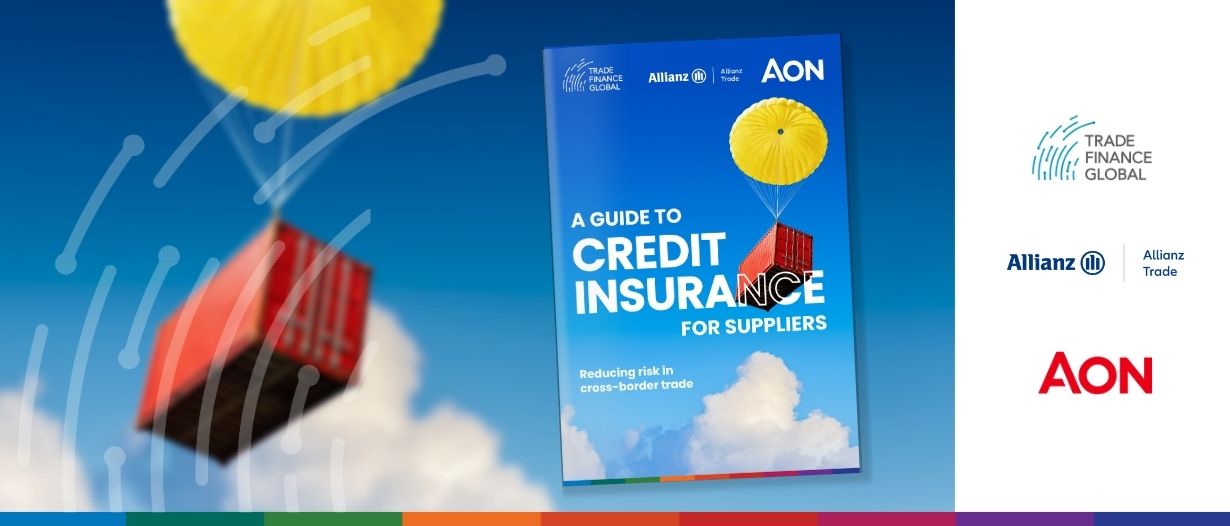




- Trade Finance Global’s (TFG) latest guide demystifies trade credit insurance (TCI) for businesses of all sizes, covering the key parties involved, the main risk categories and which insurance types address them, and regional variations.
- TCI is a largely misunderstood tool in cross-border trade.
- While large corporations employ dedicated in-house experts to navigate it, SMEs frequently lack the knowledge to unlock its full value.
As risks rise, so do insurer demands in trade finance.
When deciding what to write guides about, Trade Finance Global (TFG) draws on feedback we hear from attendees of our own and wider industry events, as to the subsets of trade finance with the most opacity. What transpired is that, when it comes to trade credit insurance (TCI), many of the larger exporters have in-house counsel hired specifically as experts on the subject. These experts can work with insurers to find the best solution for them; the supplier themself is often blind.
That’s all well and good for multinational corporations (MNCs), but small and medium-sized enterprises (SMEs) often have little to no idea about exactly how much value TCI can unlock. More than stability and security – commodities which are always of paramount value – TCI can actually free up liquidity.
The insurance world can seem a complex one at first glance, with its own niche terminology and specialist requirements. However, it is only as complex as international trade is: the myriad of policy types, contracts, and coverage areas correspond to the myriad of risks exporters are exposed to every day. This guide demystifies insurance in cross-border trade, giving suppliers enough grounding to approach insurers with confidence, rather than arriving blind.
Understanding the basics makes traders more attractive to insurers. Drawing on our work with major players in the cross-border trade space, this guide stands to give more information to the prospect pool.
This guide is for any business in trade finance, but especially SMEs importing and exporting for the first time. It is designed to serve as a resource that an insurer might provide to a prospective client – covering everything the insurer will require of that client, and everything the client needs to understand about the insurer’s offering. But, using TFG’s vast and global network, it will be free to access and stand to democratise the industry.
Two areas of particular complexity are addressed directly: the range of parties with whom insurers interact, and the degree to which insurance offerings vary across regions.
This guide is a pretty unique offering for a few reasons. We include:
- A glossary of hundreds of key terms and acronyms, so jargon can’t be a barrier to access, as well as a who’s who, covering the insurer, broker, underwriter, export credit agency (ECA) and more.
- A summary of the most popular risks, what subcategories these risks break down to, and which insurance types can mitigate them.
- FAQs provided and answered by experts.
- Case studies with Aon, UK Export Finance (UKEF), HSBC, Howden, and more.
- A diagram depicting the lifecycle of a TCI policy.
- An example of an application form for a single buyer seeking comprehensive non-payment insurance. It’s nearly impossible to understand the theory behind a concept without seeing exactly what it is that a supplier would be faced with when taking the plunge and seeking insurance.
Our writers are journalists and will never develop the wealth of knowledge which players with decades of experience in the industry have accumulated. We’re extremely grateful to the contributors to this guide for their expertise and patience in explaining concepts that we never would’ve understood without their help.
A special thanks to our partners, Sarah Murrow, President and CEO of Allianz Trade in North America, Meera Saunders, Client Director at Aon, and Madeleine Whiteley, Client Director at Aon.
The risks of today are unlikely to be the risks of tomorrow. While it’s nearly impossible to predict future threats, it is possible to protect against them. Having the right type of insurance, with the right company, can be the difference between sailing through the storm and capsizing in it.
We hope that your central takeaway from this guide, then, is this: the risks of international trade are many, but they are not insurmountable.
Happy reading!