
















Listen to this podcast on Spotify, Apple Podcasts, YouTube, and Podbean.
- End-user needs are driving innovation in transaction banking, with banks focusing on integrated workflows rather than standalone financial products.
- Digitalisation, AI and high-quality data are helping businesses improve liquidity management, automate treasury processes, and enhance operational efficiency.
- Banks must embed services into clients’ existing systems and workflows to provide flexible, data-driven solutions that adapt to changing market conditions.
It is easy to look at the fraught geopolitical reality – US tariffs, political tensions, and the disruptive role of technological innovation – and ask how the banking world is keeping up. To the observer, innovation appears coerced by external forces demanding system-wide innovation.
However, the increasing complexity and uncertainty in global markets have not diminished the importance of end-users’ needs. Instead, individual and company requests have become central to industry advancement.
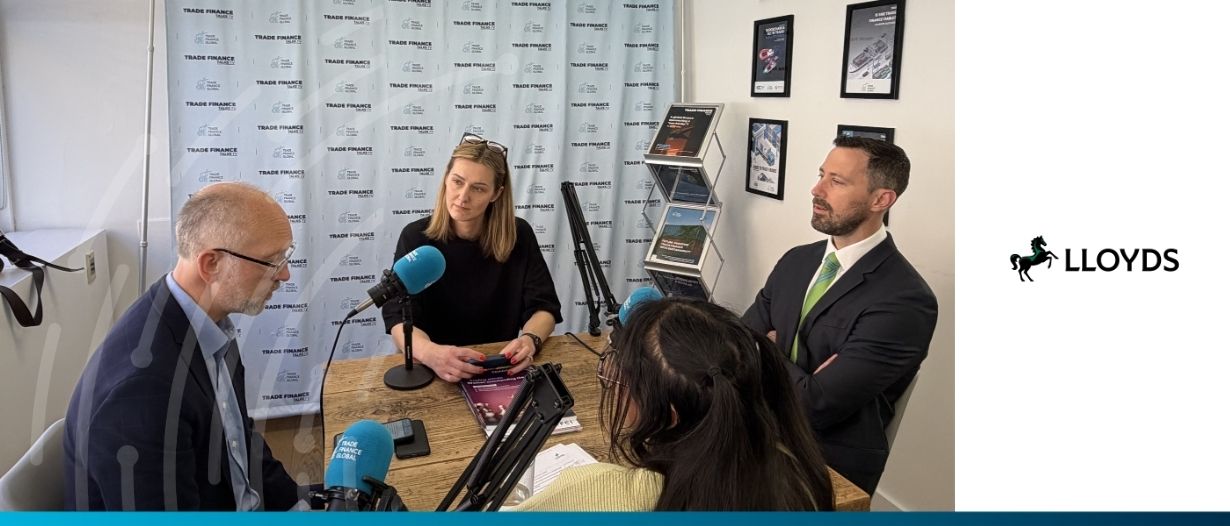
Trade Finance Global (TFG) sat down with some of the transaction banking experts at Lloyds Bank:
- James Lowrey, Managing Director, Head of Trade and Working Capital Product, Lloyds;
- Llewelyn Mullooly, Director, Data and Intelligence Product Delivery; and
- Lasma Orlovska, Head of Products, Payments and Cash Management.
They discussed how the needs of end-users have shaped transaction banking innovation from individual products towards user-centred workflows.
End-users are under pressure
One thing is clear. Geopolitical risk, the heightened regulatory environment, and the rising fraud risks are putting end-users under pressure. Those factors have increased the complexity of treasury operations and processes.
A crucial part of the pressure is liquidity management. The increased risks have pushed trade finance capital away from a just-in-time towards a just-in-case model. Companies need greater liquidity on hand and inventories at the ready to navigate supply-chain disruptions.
However, the risks of idle capital are clear. Identifying the required float and estimating risks and uncertainty to negotiate capital requirements is at the heart of end-users’ demands. That process requires data.
Two major technological revolutions are assisting users with this: digitalisation and enterprise resource planning (ERP) systems.
The UK passed the Electronic Trade Documents Act (ETDA) in 2023, making it a global leader in digitisation. Banks such as Lloyds are investing heavily in trade digitalisation processes that streamline documentation, shorten cycles, and boost working capital efficiency. Lowrey explained the digitisation process has allowed Lloyds to “cut transaction times for our customers from weeks to days, and in some cases hours, by completely removing the need to move paper around the world.”
The second part of this process involves migrating to ERP systems, such as SAP S/4HANA, that support a company’s day-to-day processes, including order-to-cash and procure-to-pay. However, despite rapidly advancing innovations that enable users to streamline critical processes, data and integration often lag, according to Mullooly.
One of the biggest gaps for end-users is in manual processes for core functions. A 2025 PwC survey found that 36% of treasury teams still use a manual foreign exchange (FX) exposure management process.
“It’s not unusual for businesses to run cash flow forecasting on an Excel spreadsheet. Indeed, some still manually reconcile end-of-day positions across hundreds of physical accounts”, said Orlovska.
Accurately estimating liquidity demands and automating decision-making for cash requirements requires an evolution in the physical systems used by treasuries.
Think workflows, not individual products.
A toolkit of working capital products and services, including documentary trade, receivables purchase, supply chain finance, inventory finance, and so on, dominates transaction banking. For banks, each of those products involves a separate system, department, and team. But that’s not how clients think. “Clients don’t experience payments separately from FX, from trade, from data. They experience a single flow of money and information moving through their business”, Orlovska said.
Product development in transaction banking requires banks to be trusted and embedded: options such as payments and FX capabilities connected into day-to-day workflows, reducing the need for manual intervention.
As global supply chains become more volatile, another key client demand is optionality, the ability to switch between products and services as conditions change. That also means clients increasingly look for tailored products, specific to the industry and sector, as well as to their workflow.
One difference here is between small and large companies and treasuries. Smaller organisations still use banks for treasury management services, assisting with a range of products, including cash flow forecasting, cash visibility, automated FX journeys, and working capital monitoring.
Larger organisations that have integrated those services through ERP or treasury management systems are looking to banks for enriched data and connectivity. That could be combining ERP data with proprietary third-party bank data to highlight cash flow challenges, or opportunities for working capital optimisation. The key for banks is to embed services into existing workflows and integrate data and analytical tools as inherent components of those workflows.
There is an opportunity for banks to become the consolidators of transaction banking processes, not just offering products and services, but by providing integrated workflows that combine products, services, analytics, and responses into a unified operating system, centred on end-user needs.
Technological innovation: AI for the client’s sake
The culmination of that unified system, the base of data, allows for automation, AI-driven insights, and the use of agents to handle key tasks.
Lloyds is currently undergoing proof-of-value testing, Lowrey explained, for agents that automate key handling tasks, which are currently manual, from end to end, including monitoring digital trade inboxes, transferring document possession, and creating draft documents.
A vital part of this process is to consider how much time is actually saved by automation – looking at the end-to-end time taken, including checking. In the same vein, assessing the relative weight of AI error compared to human error is an important test for ensuring AI works effectively, not just efficiently.
Key to that is knowing how and where to integrate AI processing. For example, AI is great at stress-testing a wide range of liquidity scenarios, but cash flow forecasting remains a judgment-intensive, human-led process.
“AI is only as effective as the quality, the reliability, and the connectivity of the underlying data”, Mullooly noted, “so data quality, ownership, lineage, and the control frameworks matter enormously”. That is why getting the workflow right, with analytics and data collection embedded, is crucial – moving too fast only increases risk.
The same is true of even newer innovations, such as tokenisation.
Tokenisation collapses the separation that exists between payment instruction and settlement. That means you can build conditions into the movement of value itself, overhauling the existing operating model.
The integration of tokenisation with existing traditional infrastructure is key. Lloyds’ Gilt purchase using tokenised deposits on a public blockchain in January this year proved it is possible. But true integration will only occur when there is broader end-user demand for the product.
Transaction banking has a unique position, straddling a breadth of financial industries, from trade to commerce to corporate. Transaction banking infrastructure integrates with small and medium-sized enterprises (SMEs) and the largest commercial giants.
That makes the potential for innovation system-wide. But that innovation has to be led by the needs of the end-user, by understanding how clients visualise financial flows, and in conjunction with treasury departments.
PwC’s survey found that for treasurers, market conditions ranked only 8th in their list of priorities. Working capital, cash and liquidity management, and capital structures all ranked higher.
Innovation has a dual role to play. Responding to the global market volatility and insulating businesses so that they can operate regardless.
Sponsored by Lloyds
All lending is subject to status. Eligibility criteria apply.
Lloyds and Lloyds Bank are trading names of Lloyds Bank plc. Registered Office: 25 Gresham Street, London EC2V 7HN. Registered in England and Wales no. 2065. Telephone: 0207 626 1500.
Authorised by the Prudential Regulation Authority and regulated by the Financial Conduct Authority and the Prudential Regulation Authority under Registration Number 119278.
Listen to this podcast on Spotify, Apple Podcasts, Podbean, Podtail, ListenNotes, TuneIn