
















- Commodity traders face significant currency risk when buying and selling in different currencies, making FX hedging essential to protect profit margins from exchange rate fluctuations.
- Forward contracts are the most widely used hedging tool, allowing traders to lock in exchange rates and eliminate currency risk throughout the transaction lifecycle.
- While the US dollar remains dominant in commodities trading, the offshore Chinese yuan (CNH) is gaining traction, accounting for 8.5% of global currency transactions in 2025 and supporting increased trade across the Asia-Pacific region.
In an increasingly uncertain world, it can be oddly comforting to know that some risks persist no matter the geopolitical environment. Among them is currency risk, which affects almost anyone trading across borders and with multiple currencies.
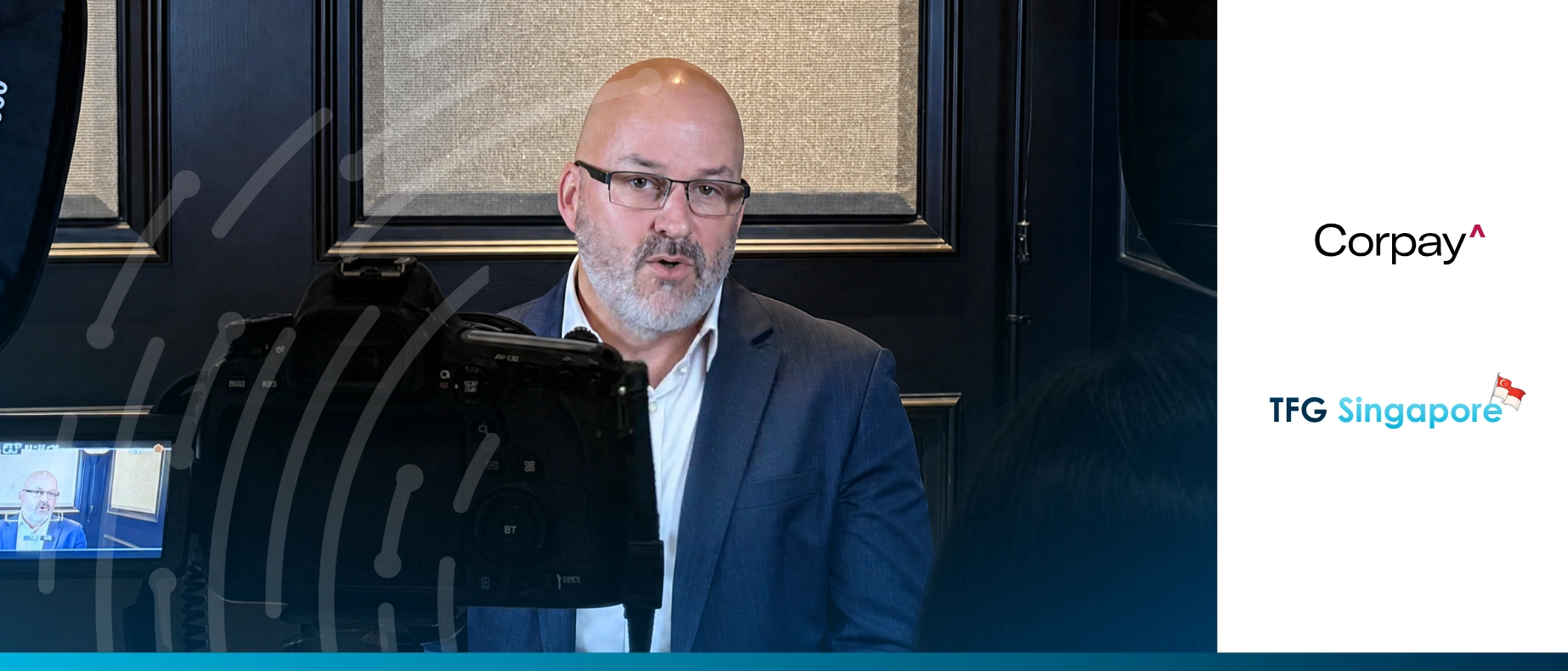
At Trade Finance Global (TFG)’s inaugural Singapore conference, Simon Bishop, Managing Director at Corpay, spoke on a panel about liquidity access for small and medium-sized enterprises (SMEs) in the Asia Pacific (APAC).
Besides changing regulations, restricted access to financing, and the lingering consequences of post-pandemic fraud cases, SMEs and midcaps in APAC must also contend with persistent currency risk in their international transactions.
TFG sat down with Bishop to find out more about the currency risks faced by commodity traders in the region and how foreign exchange (FX) hedging can help ease the burden.
Currency risks and where to find them
Commodity traders carry out their transactions in one of two ways. The majority of commodity transactions are completed entirely in US dollars, even if neither the buyer nor the seller is US-based.
This means “there’s no risk involved in the transaction” in terms of FX, explained Bishop. Despite recent geopolitical turmoil, the US dollar remains the world’s reserve currency, and its fluctuations are so tiny that dollar transactions are often reliably risk-free.
However, some transactions are completed using a mix of US dollars and another local currency: for example, if a trader buys a commodity in a local currency and later sells and gets paid in dollars, or vice versa, if they purchase in dollars and sell in a local currency.
In these cases, the trader is exposed to a significant risk: if the local currency fluctuates in relation to the dollar – for instance, as the Argentinian peso did in recent years – this eats at the trader’s margin and could result in a loss, especially if the sale happens weeks or months after the original purchase.
This second type of transaction is where currency risk management techniques are most relevant, often driven by cross-border payment companies like Corpay. “We are effectively managing the risk between what happens at the inception of the transaction and what the trader actually gets paid in so that there isn’t any pain for the client,” said Bishop.
Trimming the hedge
Risk management techniques come in different forms. Natural hedging is perhaps the most straightforward one, which simply involves using the same (non-dollar) currency for both the purchase and the sale of a commodity.
However, “that’s very difficult to do unless you have a trade that is actually in that same currency,” said Bishop. Commodity trading almost always involves buying and selling across multiple countries, which inherently means dealing with different currencies.
A slightly more sophisticated natural hedge involves having roughly similar incoming and outgoing cash flows in the same currency.
For example, if a trader buys $10 million worth of a commodity in yen and intends to sell it in euros while, at the same time, buying about $10 of another commodity in euros to sell in yen, they are mostly protected against currency risk: if the yen depreciates against the euro, any loss they have made on one transaction will be recouped by the windfall of the other transaction.
However, the most common currency risk management technique by far is through forward contracts. “A forward contract is where you effectively lock in the exchange rate of a different currency being converted into a base currency at some point in the future,” explained Bishop.
This completely removes the risk of currency fluctuations, as the trader is guaranteed an exchange rate no matter what happens between the moment they buy the forward contract and when they sell the commodity.
“In the commodity space, most of our clients will do a back-to-back hedge,” said Bishop. This means traders “do the underlying commodity trade and then instantly do the foreign exchange trade that removes the risk completely.” This eliminates currency risk as it arises, even in multi-currency trades.
Dollars and yuan
Despite the talk of de-dollarisation in other areas of finance, the US dollar is very much still dominant in the commodities space.
“The vast majority of transactions generally have the dollar involved at some point,” said Bishop, whether in the form of dollar-to-dollar transactions or as the preferred currency of one of the parties in a trade.
Some specific commodities are being increasingly purchased in euros and received in US dollars, but by far the biggest trend in the past year has been the rise of the CNH – the offshore Chinese renminbi.
The CNH is the Chinese yuan traded on the offshore market (unlike the CNY, which is the yuan traded inside China). While the CNH and the CNY are subject to the same exchange rate, they are not technically the same currency: the CNH is regulated by the Hong Kong monetary authority, can be traded by non-Chinese nationals, and is not subject to the same currency restrictions as the CNY.
In 2025, the yuan made up 8.5% of all currency transactions, up from 7% just three years earlier. Earlier this year, Australian metals giant BHP agreed to price more of its iron ore in yuan after months of negotiations with China’s state-backed iron ore buyer, China Mineral Resources Group.
A potential push by the Chinese government to internationalise the yuan is being complemented by the current economic conditions. “The CNH market is very liquid, so it’s very easy to hedge, and it allows for the facilitation of the transactions into mainland China,” said Bishop.
The growth of China’s economy, and its ever-increasing trade with its neighbours, has further encouraged trade in yuan: “China’s influence in the broader APAC region has also made it easier for those transactions to occur,” Bishop explained.
The pros of local currencies
For the security of transactions in these universally recognised currencies, though, executing trades in local currencies does have its benefits. “Quite often, clients will be able to facilitate a transaction more easily if it is denominated in a local currency, and they may be able to get a discount, for instance,” said Bishop.
This is because dealing in local currencies both simplifies things for the supplier and shifts the risk onto the commodity trader. “Clients are often happy to do that because the complexity of dealing in local currencies is offset by the discount,” explained Bishop.
However, commodity traders must have a way to manage the currency risk they have brought onto themselves – hence the hedging techniques.
Because of this, almost all traders use some kind of forward contracts – usually basic forwards with back-to-backing, where “you have an agreement of what currency is going to be exchanged at a particular rate at a particular point in time in the future,” explained Bishop.
The instrument is simple, especially compared to other popular derivatives or more complex types of forward contracts. The reason is clear: commodity traders aren’t trying to speculate on a currency or profit off its fluctuations.
Instead, clients “will remove risk completely and only worry about their margin – that’s all they’re interested in right now,” said Bishop.
—
Earned or not, global finance often gets a bad rap: risky and speculative, it can sometimes seem like a complex world abstracted from real-life economic activity. Beneath the noise of hedge funds and derivatives desks, though, lies the foundation of the global economy, powered by commodities traders and suppliers from around the world.
FX hedging and forward contracts are where global finance comes into its own: defying the stereotypes of speculative and abstract instruments, they are tools that tangibly reduce risk and keep the world economy going.