
















- West African cocoa farmers remain largely disconnected from global markets, limiting their ability to benefit from sustainability premiums and fair trade initiatives.
- Climate change, deforestation, smuggling, and inadequate financing are undermining cocoa production and threatening the long-term viability of the sector.
- Experts argue that stronger regional cooperation, improved traceability, and an African cocoa exchange are essential to creating a self-sustaining and equitable cocoa industry.
In 2026, prices of oil, gold, wheat, beef, and other commodities hit all-time highs, fueled by the inflationary effects of the Iran war. But one global good has plummeted – cocoa.
In the last year, prices have fallen 70%. An industry riddled by moral and social challenges, including child labour exploitation, carbon footprint, and deforestation, is now also under economic threat.
The future of West African cocoa, in particular, being subject to smuggling, storage constraints, financing challenges, and global regulatory hurdles, is falling into question.
Trade Finance Global (TFG) sat down with Dr Tedd George, CEO of Kleos Advisory and a regional and industry expert, to discuss the regulatory, financial, and ecological frameworks needed to make West African cocoa sustainable.
The disconnect between farmers and their markets
At the moment, there is a significant disconnect between smallholder cocoa farmers and the international market.
Production in West Africa follows a similar process region-wide: local farmers sell to aggregators, known as ‘traitants’ in Côte d’Ivoire, who take the cocoa to warehouses for major exporters to collect. Farmers themselves, selling from the farm gate, are isolated from the prices of global cocoa.
Only 48% of Côte d’Ivoire’s 2024 crop, the world’s largest cocoa exporter, could be traced back to its origin, according to research published in May 2026. Côte d’Ivoire alone accounts for 36% of global cocoa bean production, meaning nearly a fifth of the world’s supply is untraceable.
This lack of transparency in cocoa supply chains is a major issue given the introduction of international regulatory standards, including the European Union’s (EU) Deforestation Regulation (EUDR).
The EUDR mandates that all cocoa and cocoa-derived products exported from the European market must be traceable to their exact origin, and must be legally produced on land that has not been deforested after 31 December 2020.
But the cocoa market’s opaque nature points to a broader issue: the lack of contact between West African cocoa farmers and global markets.
This is a major problem when trying to create an incentive structure for fair trade and sustainability standards, explained George. Cocoa is collected by local aggregators, with no price differential for production standards, meaning farmers never see the higher costs associated with ‘fairtrade’ chocolate goods.
Without direct contact with international markets willing to pay a premium for sustainability standards, most farmers stand to make little or no return from an investment in sustainable and fair trade practices.
Governments and regulatory bodies have a key role to play here. The EU’s Carbon Border Adjustment Mechanism (CBAM) charges carbon-intensive industries an additional adjustable rate relative to their carbon emissions, designed to mimic the internal emissions trading system (ETS).
CBAM has not been applied to agricultural produce yet. However, George estimates that a current cocoa exporter, making an annual profit of €450 million, could suffer yearly losses of up to €350 million if current CBAM mandates were applied.
Both the EUDR and CBAM can inspire sustainable practices, but they need to ensure they do not bankrupt West Africa in the process.
One positive step has been Côte d’Ivoire’s development of biometric cards for farmers. The cards allow them to trace beans from production to export, and make sure that farmers are paid a fair price. It also allows the government to trace plantations, protecting forested lands and increasing transparency.
Putting international cocoa importers in touch with individual farmers requires the investment and financing of similar initiatives.
“Farmers and cooperatives have to be involved with the international market. Getting financial incentives aligned with environmental and social ones is what brings sustainable production,” said George.
The ecological challenge
Cocoa isn’t indigenous to West Africa – it’s originally from South America. However, the climate in West Africa has been historically ideal for cocoa beans, a very delicate crop that requires predictable cycles of rain and sunshine.
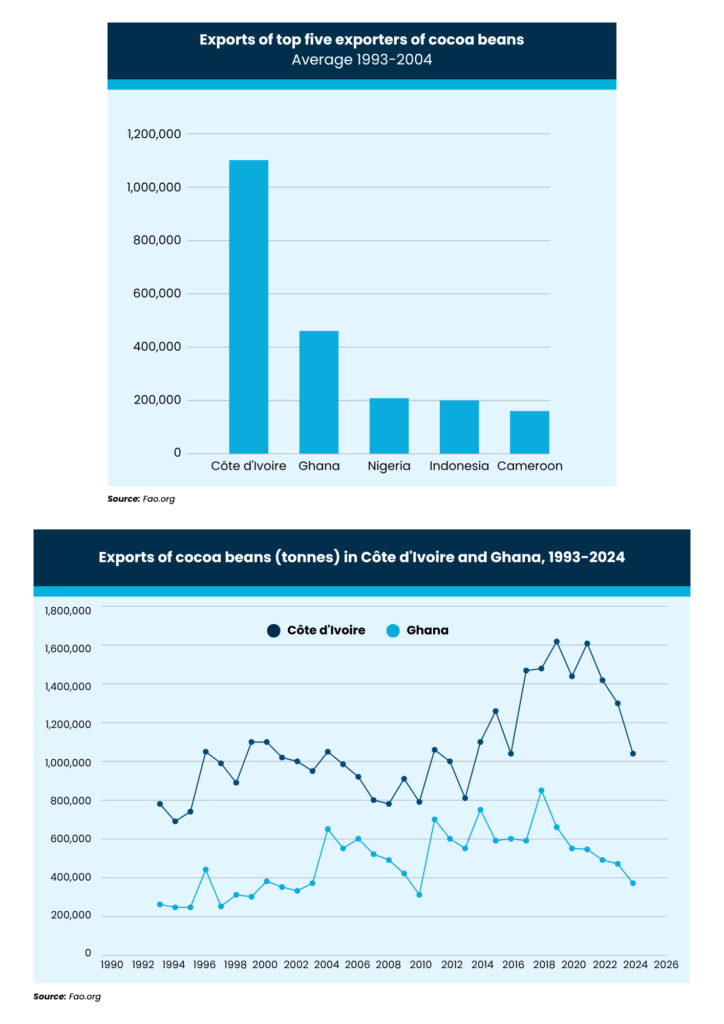
Since 1987, Côte d’Ivoire has been the leading global producer of cocoa beans, followed by Ghana and Nigeria.
However, the ecological balance is shifting under the twin pressures of deforestation and climate change. In the last four seasons, cocoa production in Côte d’Ivoire and Ghana has decreased by 15.3% and 4.8%, respectively.
The shifting weather patterns have exacerbated the spread of diseases such as black pod and swollen shoot disease, making them endemic in Ghana and Côte d’Ivoire. Land use is further compromised by illegal industrial production, such as mining.
“Illegal gold mining in Ghana, unsustainable production, and deforestation are leaving the land completely unusable. Usually, you see a bounce back in production the following season, but the bounce back hasn’t occurred,” explained George.
Sustainable land use management isn’t just an idealistic dream from Western regulators: it is a necessary overhaul if cocoa bean output is to be maintained.
Worth their weight
Another key challenge for the cocoa bean industry in West Africa is the prominence of smuggling.
As George emphasised, cocoa is very valuable for its weight: “A tonne of cocoa is probably worth 20 tonnes of wheat, or maybe more,” incentivising smuggling.
A further complication is the fixed price system. Ghana’s Cocoa Board (COCOBOD) sets fixed prices, once a year at the start of the harvest, whereas Togo adjusts recommended prices twice a month based on the global market value.
Thereby, when cocoa prices soared in 2024 and 2025, peaking at $10,900 per ton in May 2025, there was a clear appeal for smuggling cocoa out of Ghana and selling it to the global market through Togo.
COCOBOD estimates that between 2021 and 2025 smuggling resulted in a $1.1 billion revenue loss for Ghana.
According to George, smuggling currently services the market gap in cocoa bean exchange within West Africa. Different parts of the cocoa production process are specialised, from farming the beans to drying, grinding, and processing them.
Currently, if there is a bean deficit, say for grinders in eastern Nigeria, while there is surplus production in western Cameroon; smuggling is one of the only ways to get the beans across the border, because the paperwork and costs of legal trade are too complicated.
A further complication is farmers trying to hold onto their beans because they expect prices to rise. The end of the season is in April and May, and the new crop begins in October. Farmers often hold onto their beans, expecting prices to rise, but poor storage and the spread of disease can lead to crop deterioration.
Without a mechanism for the exchange and financing of cocoa crops, farmers lack power and beans are wasted.
Understanding what we mean by child ‘labour’
Perhaps the biggest stigma around cocoa production is the use of child labour. 1.56 million children currently work on cocoa farms across Côte d’Ivoire and Ghana. Child labour is a serious issue, with children being trafficked-in from Mali, Guinea, Burkina Faso, and getting forced to work on cocoa plantations.
However, it’s crucial to note that 45% of the children in Côte d’Ivoire and Ghana also live in households involved in cocoa production. George highlighted that it’s critical to distinguish between ‘child work’ and ‘child labour’ in public discussions and regulatory discourse.
“Anyone who’s the child of a farmer is going to work on the farm. That goes for the UK, the US, as well as Africa,” he emphasised.
The importance is distinguishing between what type of work they are doing, whether it is inappropriate for a child – for instance, whether it involves the use of machetes, pesticides, or machinery – and most importantly, whether they are still going to school.
For many children in West Africa, working on the family farm while still attending school is not different to their Western counterparts doing morning chores and appropriate work over the weekends.
“The regulators are aware of this difference, but not the general public at all. It’s a little patronising and also massively ignorant to say you can’t have children working on farms. It is about it being appropriate work,” said George.
Additionally, the average age of a cocoa farmer is around 55. Thereby, young people must come in and learn the skills necessary to keep the industry alive.
However, despite this crucial distinction, George explained that if the nearest school is 20 miles away, children will not attend, no matter what. If a farmer has no other options, unsustainable practices – from child labour abuse to ecological destruction – become unavoidable.
Reclaiming pricing power
Sustainability in cocoa doesn’t just encompass the green impact. Sustainability is financial, governmental, regulatory, social, educational, and labour sustainability across the supply chain.
For George, the future of the West African cocoa industry needs an African cocoa exchange.
At the moment, despite the clear dominance of West Africa and Latin America in cocoa production, prices are set by the New York and London stock exchanges, seemingly based on South Asian and African markets.
The development of four national exchanges in Côte d’Ivoire, Ghana, Nigeria, and Cameroon, alongside an exchange between them, would allow the countries that own production to reclaim control of their own prices.
Moreover, the development of warehouses where farmers can deposit cocoa and receive a receipt that banks lend against could protect farmers as well. Giving them the ability to move cocoa wherever it’s needed for processing would crack down on smuggling chains.
In the meantime, West Africa is working to establish its own sustainability standards. The African Regional Standard for Sustainable Cocoa (ARS-1000) establishes guidelines to support environmental, social, and economic sustainability in African cocoa production.
For West Africa, the lesson is not just sustainability, it is self-sustainability. It’s not enough for the EU and western bodies to push regulation into the industry. Rather, through cooperation and capacity building across West African governments, cocoa could become a truly sustainable and invaluable commodity that contributes to the economic development of the region’s emerging markets.