

















-
The global trade credit insurance market is projected to reach a value of $25.3 billion by 2033 as volatility becomes a permanent fixture in global trade.
-
While the industry currently relies heavily on probabilistic models to manage risk, it is beginning to adopt agentic AI that can autonomously reason and plan.
-
AI has successfully moved beyond the pilot stage in the specific areas of submission intake, appetite matching, and claim scope management.
Volatility is no longer an event-driven, periodic state of affairs. The past couple of years have seen supply chains get completely reconfigured as a result of geopolitical turmoil, and as volatility cements its position as a constant in global trade, so does risk.
Under these circumstances, risk mitigation cannot operate as an afterthought: resilience has to be built directly into transactions. This means that trade credit insurance is more important for traders than ever before. The global trade credit insurance market was valued at $13.7 billion in 2024, and this number is expected to almost double by 2033, climbing to $25.3 billion.
However, for it to meet the needs of an industry evolving on par with how quickly artificial intelligence (AI) has made us forget how to write emails, trade credit insurance must embrace automation.
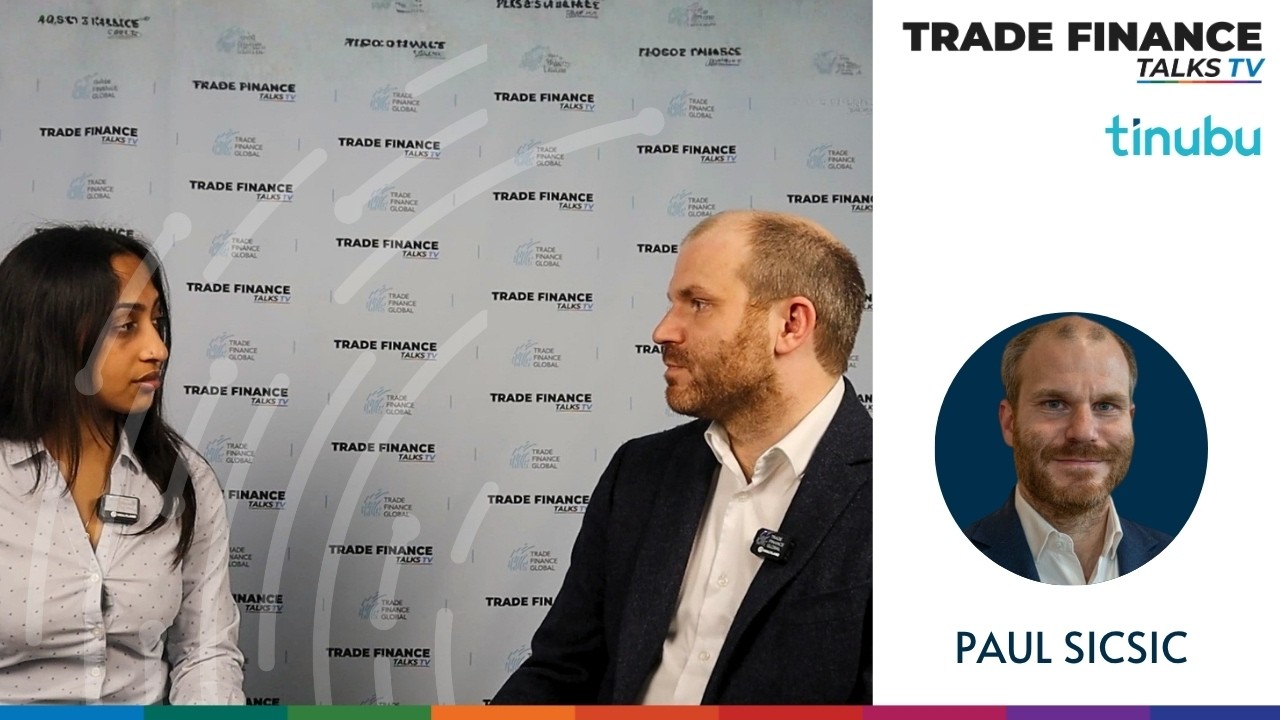
In order to unpack how exactly AI is transforming trade credit insurance, Trade Finance Global’s (TFG) Deputy Editor, Mahika Ravi Shankar, sat down with Paul Sicsic, Product and Transformation Leader at Tinubu, who works directly with trade credit insurance customers to understand their pain points and harnesses technology to address them.
But to explain the role AI plays in all of this, Sicsic first unravelled how automation is being deployed beyond the jargon, and what models are driving this transformation.
Back to the basics: Probabilistic models
“In trade credit insurance, we have a bit of a lag compared to other industries in the use of AI,” said Sicsic. “The models that are most used today are probabilistic models; the type of machine learning that you can train through correlation on a strict data set.”
The AI realm is split into two: probabilistic and deterministic. Deterministic models are systems that can definitively say that an input will have a particular output, whereas probabilistic models take into account the uncertainty inherent in real-world data.
Rather than pushing absolute numbers, probabilistic models make probabilistic predictions. Instead of treating data as unchanging, they use data to understand patterns, from which they can estimate the maximum likelihood of an outcome. This is particularly effective in approaching risk that stems from volatility.
“We started to see some agentic use cases around risk,” said Sicsic. “This can be a user trying to understand, through a given portfolio, what the risk profile could be, but is also accessing open source data and trying to sensitise it.”
Agentic AI is fundamentally probabilistic. It leverages large language models (LLMs) and machine learning to determine the best possible action in dynamic environments, and has the ability to autonomously reason, plan, and act. When given both a risk profile and external data, agentic AI can analyse patterns and probabilities and decide on the best course of action.
For Sicsic, what’s striking in this age of AI is that training AI agents, once a cumbersome process, is becoming increasingly easier and faster. AI models are fed curated data and chosen algorithms based on the specific goals and expectations for the model.
Effective training requires high volumes of good-quality data that is curated for training, and the training process is revised through feedback and results. “Today, it is much easier to do the training,” said Sicsic.
Tinubu has adopted a modular approach to AI, which breaks down complex AI systems into smaller, independent components, rather than relying on a single, monolithic model. These modules – such as data ingestion, processing, and output generators – work together.
Through the modular approach, “You can focus on one given pain point, one part of the scope that you want to optimise,” explained Sicsic. “That flexibility, coming from the way we’ve built the technology, is able to help carriers do the transformation they’re looking for.”
Moving beyond the pilot stage
For trade credit insurance, AI has surpassed the pilot stage in three use cases: submission intake, appetite matching, and claim scope.
Submission intake refers to how to easily structure information that’s being received through a portal, including email (essentially, AI content being structured by AI). Automating submission intake enables the streamlining of the underwriting process, a financial risk assessment calculated by insurance companies.
The second primary use of AI beyond the pilot stage is appetite matching. Appetite matching in trade credit insurance refers to aligning a buyer or risk exposure with an insurer whose risk appetite fits that particular profile. It means placing a risk with the insurer most willing to underwrite it.
This entails determining how to quickly prioritise the work of underwriters and risk teams, so they can concentrate on the businesses the company wants to pursue.
The third part, the claim scope, refers to the defined boundaries of what a claim covers, and just as importantly, what it doesn’t cover, under policy terms. Through automation, the claims process can be simplified, enabling real-time updates, quick resolutions, and recovery management tools.
According to Sicsic, for all three cases, the focus is largely limited to automating the process of inputting data. Although the appetite matching process is starting to harness AI to guide users, the true potential of automation in working with clients is yet to be seen.
He noted that in trade credit insurance, automation has some way to go before it can start proposing decisions or making decisions on behalf of commercial risk underwriters.
“As people get used to this type of technology and as they trust it a little bit more, the value will increase, and these models will be trusted with more and more complex tasks,” he said. “But it will take a little bit of time.”
The hype of generative AI
Generative AI (Gen AI) has also emerged as one of the most talked-about technological shifts of recent years. But is it merely a buzzword that generates lots of attention?
A 2025 study by the Geneva Association found that 70% of surveyed insurance customers used off-the-shelf Gen AI tools when buying insurance. However, 40% expressed concern over data privacy and misinformation regarding their insurance decisions, and again, 40% ranked the absence of a human touch as a top concern over insurer-provided Gen AI tools.
Although Gen AI is actively being deployed in trade credit insurance, particularly by adding it on top of models designed for specific objectives, “There is still a bit of hype,” said Sicsic. “Everyone’s talking more about it than actually using it, and that’s the gap we need to close as an industry.”
Closing that gap means ensuring the technology delivers tangible value to different teams. That could involve enabling specialists to focus on where their expertise has the greatest impact, or accelerating processes to improve responsiveness and competitiveness.
Ultimately, demonstrating clear proof of success will be critical in narrowing the divide between industry-wide enthusiasm and real-world implementation.
—
Now speaking directly to insurers apprehensive about deploying AI, “Everyone is still testing and trying to figure out what the next step is going to be” said Sicsic.
He warned against attempting to start by doing something too big, too complex, and potentially too detrimental, arguing that if you start small, it will be much easier to gain knowledge and expertise, while accessing the success proof points needed to continue developing.
“What is really important is that you stay in control,” he said. It is much easier to maintain that control when taking small steps, viewing AI deployment as a process, and building trust at each checkpoint.