












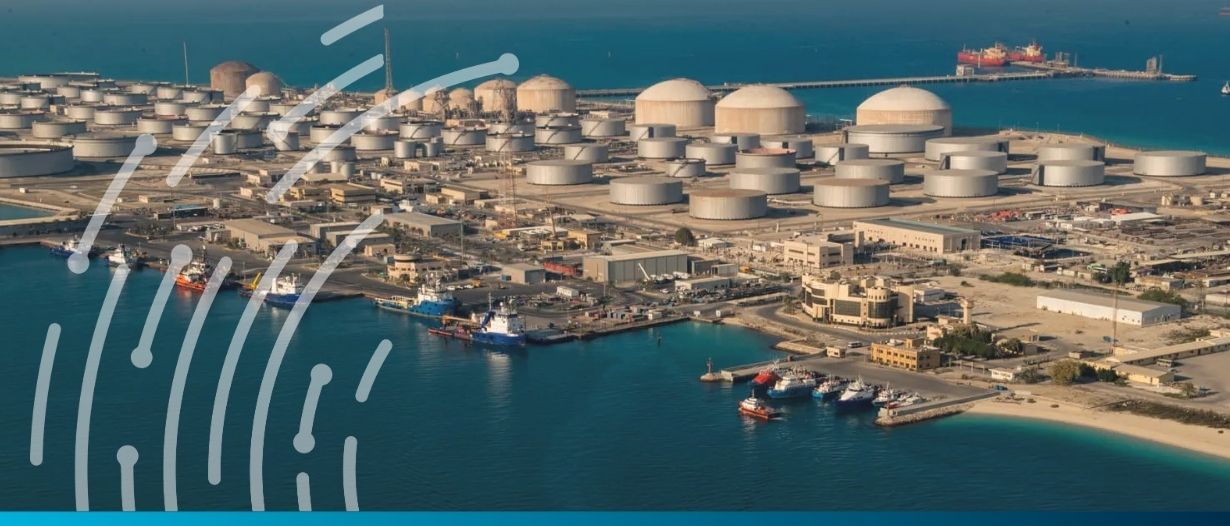

- A drone strike forced Saudi Aramco to shut its 550,000 bpd Ras Tanura refinery amid escalating Iranian retaliation for US-Israel attacks.
- Brent crude jumped to $80 per barrel on this news.
- Tanker traffic through the Strait of Hormuz collapsed by 38% as operators and insurers withdrew.
Saudi Arabia’s state oil company, Aramco, has temporarily shut down its Ras Tanura refining facility after it was hit by a drone today, on Monday, 2 March, according to Reuters. This comes on the third day of strikes launched by Iran in retaliation for Saturday’s US-Israel attacks.
The Ras Tanura facility – a 550,000 barrel per day (bpd) plant – marks a “significant escalation, with Gulf energy infrastructure now squarely in Iran’s sights,” Torbjorn Soltvedt at Verisk Maplecroft told Reuters.
The strike is the second blow to Aramco’s Eastern Province complex in under a fortnight. Aramco’s Juaymah LPG export terminal – one of the world’s largest, shipping more than 450,000 tonnes of propane and butane per month – has been offline since 23 February after structural damage to its delivery infrastructure, forcing the cancellation of cargoes through March.
Brent crude oil prices, the international benchmark, surged to $80 per barrel on the Ras Tanura news alone.
Oil production has also been suspended in Iraqi Kurdistan, with giants including Dana Gas citing the “extraordinary and war-like conditions” in the region. In Kuwait’s Mina Al-Ahmadi refinery, with a capacity of 346,000 bpd, falling shrapnel on Monday morning injured two workers, though production has not yet been affected.
International airports in Dubai, Abu Dhabi, and Kuwait were all struck by Iranian munitions, leading airlines to suspend flights across the Middle East; flight maps show airspace over Iran, Iraq, Kuwait, Israel, and Bahrain virtually empty, which are primary logistics link between Western and Asian markets. Iranian strikes have also paralysed major shipping hubs in the UAE and Oman, including the port of Duqm.
Simultaneously, the escalating conflict has caused havoc in the Strait of Hormuz, through which approximately 20% of global petroleum liquids consumption and 30% of global crude oil flows. While it has not been formally closed, the withdrawal of commercial shipping operators – including Hapag-Lloyd, CMA CGM, and Maersk – and insurers has produced a de facto blockade for most of the global tanker fleet.
Prior to the strikes, war risk premiums for Hormuz transits stood at around 0.25% of insured hull and machinery value; industry sources indicate these could now reach 0.5% or higher. For a container vessel valued at $150 million, that translates to a premium rising from $375,000 to $750,000 for a single transit.
On average, 107 cargo-carrying vessels transit the Strait of Hormuz each day, equating to around 10.3 million deadweight tonnes (dwts). Put another way, more than 3,000 vessels pass through each month, at a chokepoint that is just 21 nautical miles wide at its narrowest.
But overall traffic dropped 38% on Saturday, with 72 cargo-carrying vessels over 10,000 dwt making the transit, down from 116 the day before. By Sunday evening, just seven smaller tankers and one gas carrier had passed through, compared with 56 tankers by the same hour on Friday.
According to analysts, this disruption is made more severe by the genuine risk to physical supply. A Palau-flagged tanker named Skylight was reported struck off Oman with injuries, and crew evacuation was reported. A separate vessel was hit by an unknown projectile north-west of the UAE’s Mina Saqr area, with a fire subsequently extinguished.
The crucial distinction between disruption in the Strait of Hormuz and last summer’s Houthi attacks in the Red Sea is that the Red Sea has a bypass – the Cape of Good Hope route, which adds 10 to 14 days and significant fuel costs. There is no equivalent bypass for Gulf exports.
A pledge from the Organization of Petroleum Exporting Countries (OPEC+) to raise output was only modest – at 206,000 bpd – particularly given the group retains some 3.5 million b/d of spare capacity.
Tehran has long warned that it could use its strategic location to shut the Strait down in retaliation for military aggression.