













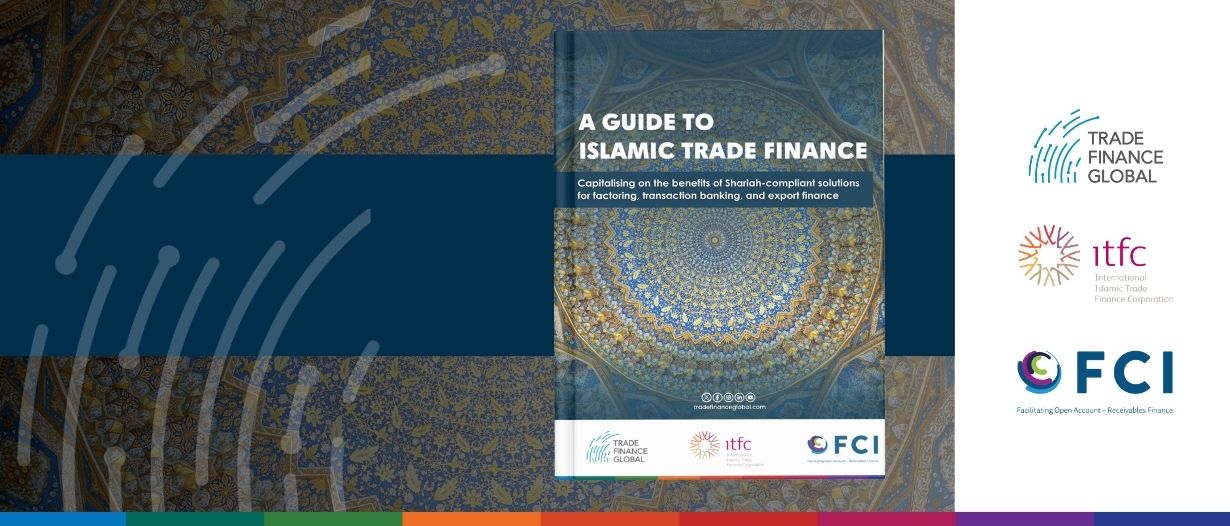


- Trade Finance Global (TFG) is excited to launch the industry-first comprehensive guide on Islamic trade finance.
- This is in collaboration with FCI and the International Islamic Trade Finance Corporation (ITFC), a member of the Islamic Development Bank (IsDB) Group.
- The guide brings an extensive glossary of key vocabulary, case studies, and deep analysis of various veins in Islamic trade finance, transaction banking, and factoring.
Islamic financing principles have underpinned the development of a capitalist, globalised economy since the 9th century. During this period, the Islamic Golden Age, Arabic silver dirham coins circulated through the South China Sea, to sub-Saharan Africa, to northern Europe. This laid the foundation for some of the most prolific Caliphates in human history.
The Golden Age saw Islamic commerce apply bills of exchange, forms of partnership, promissory notes, and many more. These were only picked up in medieval Europe 400 years later.
It was also during this period that systems of Islamic finance began to arise, from waqf systems of trust to the prohibition of interest, or riba. But as global systems of trade and trade finance evolved around the world from the 16th-century onwards, in coincidence with the spread of European empires, Islamic finance concepts were shelved in favour of non-religious, Westernised theory.
Today, Muslims make up over a quarter of the world’s population, spread across fast-growing emerging economies, like Indonesia and Pakistan, and established global finance and commodity hubs, like Saudi Arabia and the United Arab Emirates. Over the past decade, total trade between member states of the Organisation of Islamic Cooperation (OIC) has increased significantly, at a rate of 22.64% between 2019 and 2022.
Trade volumes grew steadily across OIC countries, in terms of intra-OIC, but also of OIC and non-OIC trade. This reflects the deepening integration of emerging markets into global value chains and the increasing diversification of international supply networks.
As Muslim-majority economies expand, so do their liquidity needs, leading to a consumer-driven demand for financing solutions that are both internationally recognised and fully aligned with Islamic finance principles. Certain aspects of traditional finance, such as riba, discounting under bay‘ al-dayn (trading in debts), or speculating using derivatives under the prohibition of gharar (excessive uncertainty), are forbidden under Shariah law, the religious system of Islam.
Islamic finance assets are projected to reach $9.7 trillion by 2029, almost four times their 2018 levels. Islamic receivables finance is the new frontier for banks, institutions, and companies alike – responding to firms’ need for trade financing in an ethically sound, internationally recognised, and Shariah-compliant process.
This guide is intended as a thorough introduction to the world of Islamic supply chain finance and factoring. Whether you’re a student, a longtime industry insider, a businessperson who would like to capitalise on Islamic factoring’s potential, or just an interested party, this guide is for you.
It begins with a detailed cheat sheet on the various financial instruments which crop up in Islamic transactions, distilling textbook definitions into more usable segments. The guide then unpacks how Islamic principles are applied in transaction banking, and where governance sits – including the religious rationale behind Shariah-compliant finance and the role of supervisory boards.
The latter half of the guide is dedicated to factoring – why it’s necessary, how it was born, and its differences from traditional factoring processes.
Sprinkled along the guide, you’ll find a range of case studies spanning the Islamic world, intended as a testimony of Islamic finance’s enormous potential in powering real-world economies. A “cheat sheet” at the beginning of the guide should serve as a useful introduction to the most common Islamic trade finance instruments, while the glossary at the end will be a welcome companion when learning Islamic finance’s unfamiliar vocabulary: a quick reference point for those who haven’t quite learnt their murabahas from their mudarabahs.
In putting this guide together, a few conclusions became clear:
- As in its 9th-century roots, Islamic finance promotes social justice by prohibiting behaviour that can turn exploitative. These could be practices, such as paying interest or speculating using derivatives, or in relation to the very products and industries themselves, such as pornography or alcohol.
- The more complex the transaction is, the more due diligence is conducted, and the more considerations are made to ensure Shariah compliance. Shariah boards are dedicated bodies within Islamic banks that do just this, researching the financial solutions for the clients diligently.
- Under Shariah law, there is no harm in the collection or management of receivables, but their discounting is prohibited. In general, the discounting of receivables is misinterpreted as the only component which makes up factoring. But factoring is a multi-party commercial arrangement, while any financing element is a separate, secondary two-party agreement that arises only after the factoring relationship is established. An industry-wide shift in mindset is needed to start thinking about ‘Islamic finance’ and ‘factoring’ as perfectly compatible, not oxymoronic.
- Social considerations are embedded in every aspect of Islamic banking, making it an increasingly attractive and sustainable investment option. For example, because banks may not profit from late fees, these are often donated to charity; systems of trust and mutual aid, like waqf or hawalah, have underpinned the industry for centuries, and their core tenets are still seen in modern instruments.
- The future of Islamic finance is as inevitable as the growth of Muslim populations and diasporas, trade from Islamic countries, and a global economy which relies on the two.
Happy reading – we hope you learn as much as we did!