













-
SMEs, especially in emerging economies, are heavily impacted by the $2.5 trillion global trade finance gap, with supply chain finance offering a potential solution for short-term liquidity.
-
Partnerships between global and local banks, alongside technology-driven disruptors and development agencies, are essential for narrowing the SME trade finance gap, particularly in the global South.
-
Traditional risk assessment frameworks are inadequate for SME trade finance, as they fail to consider the multi-layered risks SMEs face, necessitating more flexible, portfolio-based risk models.
Small and medium-sized enterprises (SMEs) – especially those in emerging economies – are hit the hardest by the global trade finance gap, which has been stuck at an estimated $2.5 trillion since 2022.
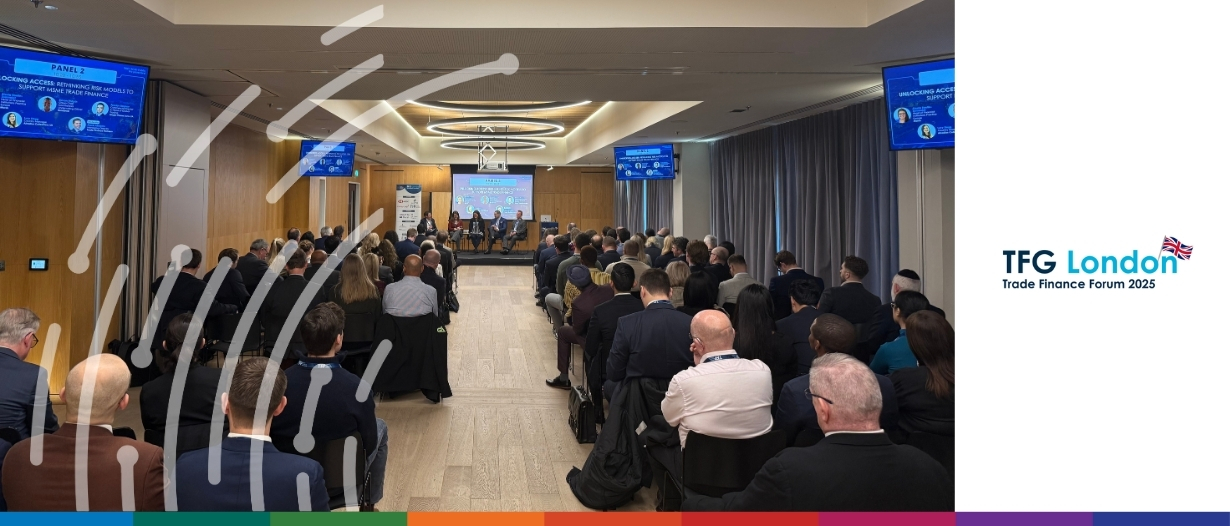
On 9 December 2025, Trade Finance Global (TFG) hosted the inaugural Trade Finance Forum in London, which brought together banks, fintechs, multinationals, and SMEs to discuss how to empower the smaller actors in the trade finance landscape.
1. SME access to short-term liquidity remains constrained by structural barriers, and supply chain finance can be a potential solution
Short-term liquidity is constrained for many SMEs and mid-market firms — not because of a shortage of capital, but because of how liquidity is distributed. Existing trade finance frameworks often fail to channel funding effectively to smaller companies, leaving SMEs particularly exposed to cash-flow pressures and elevated failure rates.
SME bankruptcies remain high: a significant share of small businesses were said to fail within their first year of operation. Cash-flow problems are cited as an important reason; however, there is debate over whether this should be understood as the root cause of SME failure, or whether it is a symptom of a deeper weakness, such as unstable demand, supply-side disruptions, or financial mismanagement.
Banks also face persistent constraints when lending to SMEs, as compliance requirements increase costs and administrative burdens, credit risk frameworks tend to penalise firms with limited financial histories, and cash-collateral requirements exclude many SMEs that lack sufficient assets to pledge.
Together, these factors have contributed to banks’ shrinking risk appetite toward SMEs. In this context, supply chain finance can be operationalised as a way for banks to provide liquidity while limiting direct exposure to smaller firms, by structuring financing around large, creditworthy corporates rather than relying solely on SME balance sheets.
2. Partnerships are essential to narrowing the SME trade finance gap – especially in the global South
Closing the SME trade finance gap cannot be achieved on a bank-to-bank basis alone. This limitation is particularly evident in countries in the global South, which continue to sit on the margins of international trade and global capital flows. Global banks must work more closely with local banks in emerging markets, which have stronger knowledge of domestic regulations, operating environments, and SME clients.
Local banks are also better positioned to absorb local currency risk, especially within two-step loan structures, where international capital is channelled through domestic financial institutions before reaching SMEs.
Beyond banks, narrowing the gap requires a broader ecosystem of partnerships, which involves technology-driven disruptors, governments, export credit agencies, and development finance institutions. These actors can be essential to bridging the SME trade finance gap by sharing risk and responsibility through guarantees, funding programmes, and risk-sharing mechanisms.
Such partnership-based models are particularly relevant in Southeast Asia, where local banks play a central role in SME financing. For instance, in the Association of Southeast Asian Nations (ASEAN) – where SMEs make up around 95% of all businesses – the Asian Development Bank’s Trade and Supply Chain Finance Program has mobilised billions of dollars in trade by sharing risk with local banks, enabling them to extend financing to smaller firms and new markets.
3. Traditional risk assessment frameworks are proving inadequate for SME trade finance
Traditional risk assessment models are poorly suited to SME trade finance. These frameworks often focus on one dominant risk in isolation – such as whether a buyer will pay – and treat that risk factor as decisive. While this approach simplifies regulatory processes and compliance requirements, it fails to reflect the reality of SME trade, where transactions typically involve multiple layers of risk.
For SMEs, risks often span supply risk, storage risk, and damage risk, all of which need to be understood collectively rather than in isolation. While large corporations can absorb operational disruptions without affecting repayment, similar risks pose a direct threat to cash flow for SMEs. As a result, single-risk evaluations are often unreliable in SME trade finance, requiring each risk factor to be clearly explained and accompanied by appropriate mitigation strategies before financing can proceed.
Insurance and portfolio-based approaches can be ways to diversify and manage risk more effectively by transferring specific risks to third parties and spreading exposure across multiple transactions.
However, a lack of reliable and standardised data on SME transactions serves as a key barrier, limiting banks’ ability to implement more flexible and nuanced risk models at scale.
4. Effective fraud prevention requires both digital tools and physical presence
Trade finance remains vulnerable to fraud, with billions being lost each year because of it. Trade finance risk management depends fundamentally on access to accurate and reliable information. While digital tools and artificial intelligence (AI) are playing an increasingly important role in fraud detection and monitoring, they cannot replace first-hand, on-the-ground knowledge.
Therefore, a two-pronged approach to risk management could be effective, where digital capabilities are combined with physical checks and local verification. Information obtained through direct engagement is ultimately more authentic and reliable than purely digital data, particularly in complex trade transactions where documentation and local practices can vary.
5. Sustainability and inclusion are reshaping trade finance
Multinational supply chains are moving towards more local or regional supplier options as they attempt to reduce their carbon footprint. Sustainability regulations are also shifting what companies need to report, and SMEs must adapt to the new requirements.
Inclusivity is also increasingly recognised across the industry, not only as a matter of representation, but as a contributor to better decision-making. As companies expand across different regions, incorporating diverse perspectives into organisational culture is becoming integral to operating effectively across markets.
Climate change and the pressure to green their supply chains are increasingly affecting how businesses operate – with many firms reorganising their supply chains and adapting their sourcing strategies.
These takeaways were drawn from the following sessions:
- ‘Liquidity where it’s needed most: Fixing the flow of short-term trade finance in the mid-SME market’, featuring Adrian Walkling, CEO, UK International Payments, Moneycorp; Ravi Sivasubramanian, Head of Trade Finance EMEA, Mizuho; Amy Clarke, Head of Short-Term Business, UK Export Finance; Eric de Vienne, Regional Head of Trade Asset Distribution Europe, HSBC; and Sean Edwards, Chairman, ITFA (moderator).
- ‘Unlocking access: Rethinking risk models to support MSME trade finance’, featuring Alexia Boutin-Somnolet, Head of Financial Institutions Practice Europe, Marsh; Preslav Raykov, Commercial Director and Head of Global Trading, Magic Flame Swiss SA; Simon Philpin, Group Chief Commercial Underwriting Officer, Bondaval; Lucy Stagg, Country Manager, Atradius Collections UK; and Mark Abrams, Managing Director, Trade Finance Partners (moderator).
- ‘Fighting fraud: Strengthening risk management through boots on the ground’, featuring Daniela Barrdear, Partner, Sullivan and Council Member, BExA; Elena Egorova, Head of Operations, Drum Advisory; Akim Kibalnik, Head of Structured Trade Finance Solutions EMEA, BBVA; James Lowrey, Managing Director and Head of Trade & Working Capital Product, Lloyds Banking Group; and Charles Osborne, Director, Trade Finance Global (moderator).
- ‘Greening supply chains: Driving sustainability through trade finance’, featuring Lauren Rabbitt, Managing Director, Go Green Now and Associate Director, ECS; Ryan Dhindsa, Managing Director, Tuffking; Benjamin French, Associate Director, CZ; and Silvia Andreoletti, Senior Reporter, Trade Finance Global (moderator).
- ‘AI and cloud in trade finance: Transforming supply chain finance at scale’, featuring Elena Sankova, Global Solution Consultant, Finastra; John Omoti, Head of Supply Chain Finance, Bank of China; Federico Avellán Borgmeyer, Chief Partner Officer, efcom; Neal Harm, Secretary General, FCI; and André Casterman, Founder and Managing Director, Casterman Advisory and Chair of the Fintech Committee, ITFA (moderator).
- ‘Building a more inclusive future: Diversity and opportunity in trade finance’, featuring Rebecca Trotter, Head of Commercial Development, Transaction Banking Products, Lloyds Bank; Gunhad Singh, Cross-Product Structuring AVP, Deutsche Bank; Lisa Ardley-Price, Managing Legal Counsel, NatWest; Charlie O’Mulloy, Associate, Trade Facilitation Programme, EBRD; and Mahika Ravi Shankar, Deputy Editor, Trade Finance Global (moderator).